
Knowledge Café explores innovation in yam research
6 November 2025
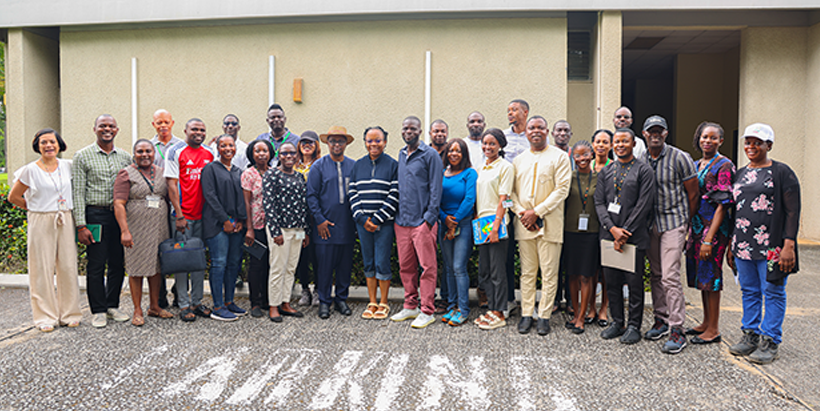
IITA–CGIAR hosted another enlightening edition of its monthly Knowledge Café seminar series, featuring a captivating presentation by Molecular Breeder, Agre Paterne. The hybrid seminar, held on 23 October, focused on “Cutting-edge genomic and bioinformatic applications in yam breeding: Current advances.” Moderated by Cassava Breeding Program Lead, Ismail Rabbi, the session spotlighted the remarkable progress achieved in yam breeding through the application of advanced genomics tools.
The Knowledge Café, organized by the IITA Communication Office, serves as a dynamic platform for strengthening internal communication, promoting knowledge exchange, and fostering innovation across the Institute. It encourages open dialogue, critical thinking, and collaborative problem-solving among IITA scientists and partners.
Introducing the speaker, Rabbi described Paterne as the lead of the yam genomics and genetics platform, commending his contribution to the development and use of genetic resources for yam improvement at IITA and within global breeding networks. He highlighted Paterne’s extensive expertise, spanning genetic diversity and population structure analysis, marker development and trait discovery, genomic prediction and selection, as well as bioinformatics and genetic resource management.
Rabbi further noted that Paterne has published over 110 scientific papers since 2016 and gained international recognition at the Advances in Genome Biology and Technology Conference in Orlando, where he received the Next Gen Leadership Award—a testament to his global influence in molecular breeding research.
In his presentation, Paterne emphasized the critical importance of yams (Dioscorea spp.) as both a food and a cash crop, supporting over 300 million people in Africa, with significant socio-cultural value. Despite challenges such as pests and diseases, he highlighted major advances made by the IITA Yam Breeding Team through genomics-driven innovations.
He explained that the team has developed Genomic Selection (GS) tools with highly informative markers for yams, reducing the breeding cycle period from four years to three years through the integration of molecular marker-assisted selection and improved seed multiplication methods.
Paterne also introduced the IITA Yam Genome Hub, an innovative database developed to streamline yam research. The hub addresses key challenges in the breeding unit, enabling quick searches for sequenced accessions and their biomarkers, file conversion across genome variant formats, and efficient storage and organization of genome-wide markers.
Among the team’s key achievements, Paterne mentioned the development of improved genome references for D. alata and D. rotundata; creation of quality control markers for breeding accuracy; deployment of highly informative markers for product advancement; refinement of the yam pangenome by adding more sequencing samples across species; and full integration of genome information into ongoing yam breeding research.
Looking ahead, Paterne revealed that the breeding team is targeting plant architecture as a major trait of interest. “We aim to develop yam varieties that no longer require staking, but can grow like Irish potatoes, making cultivation easier and more accessible to farmers,” he explained.
Sharing his personal motivation, Paterne reflected on the advice his supervisor gave him early in his career: “Your publications will speak for you; no one will know your work unless it is shared.” He encouraged young scientists to publish their research widely and to build a strong, multidisciplinary support community that fosters collaboration and growth.
Through seminars like the Knowledge Café, IITA continues to promote a culture of innovation and learning, ensuring that ground-breaking scientific research translates into real-world agricultural transformation across Africa and beyond.
Contributed by Ochuwa Favour Daramola
