
Remote sensing for avian diversity monitoring in Afrotropical urban and non-urban habitats
7 March 2025
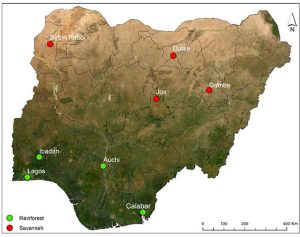
Urbanization is a major driver of biodiversity loss worldwide, with low- to middle-income countries in the global south facing the most severe consequences. The challenge is compounded by the lack of comprehensive data and logistical difficulties such as insecurity, inaccessible roads, and expensive running costs, making biodiversity studies in these regions particularly difficult. Innovative approaches are needed to track biodiversity changes effectively and support conservation efforts.
In a recent study, scientists from IITA and University of Granada used satellite remote sensing imagery to assess avian diversity in Afrotropical urban and non-urban areas. The scientists aimed to identify the most effective spectral indicators for measuring bird taxonomic, functional, and phylogenetic diversity.
The study conducted bird sampling at 400 locations across eight sites in Nigeria, covering two vegetation zones (rainforest and savannah) and two habitat types (urban and non-urban). At each location, they extracted 29 spectral indicators within a 50-meter radius.
In total, 6,477 birds from 207 species were recorded. Using advanced statistical analyses, the team determined the most effective spectral indices for biodiversity monitoring and management in Afrotropical environments.
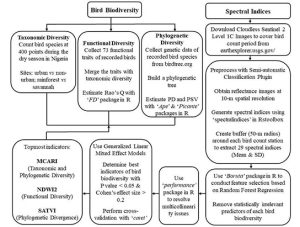
The Normalized Difference Vegetation Index (NDVI) is a widely used spectral indicator for assessing vegetation health and biodiversity. However, NDVI has limitations, including saturation in areas with high biomass and sensitivity to soil brightness, which reduces its effectiveness. The study highlights the importance of incorporating additional spectral indicators for a more comprehensive biodiversity assessment to overcome these challenges.
The researchers found that the Modified Chlorophyll Absorption Ratio Index (MCARI) was the best predictor of bird abundance (taxonomic diversity) and phylogenetic diversity. Normalized Difference Water Index II (NDWI2) was the most effective for assessing functional diversity. Soil-adjusted total Vegetation Index (SATVI) was the strongest predictor of phylogenetic divergence.
These findings emphasize the need for tailored approaches in biodiversity monitoring, particularly in the Global South, where data collection can be challenging. The study demonstrates that MCARI and NDWI2 are more effective indicators of avian diversity than NDVI, underscoring the potential of remote sensing for conservation efforts.
Study Highlights
- Boruta analysis ranks the predictive power of remotely sensed birds’ spectral indicators.
- NDVI is a poor predictor of avian diversity compared to other indices.
- MCARI, NDWI2, and SATVI are the top-ranked spectral indicators for avian diversity.
- Taxonomic diversity declines with increasing MCARI in urban areas.
- Functional diversity increases with higher NDWI2 in urban areas.
Contributed by Folake Oduntan
Related stories:
