
Over the years, breeders have faced the challenge of either undervaluing or overvaluing breeding programs during cost estimation. This has resulted in efficiencies within the programs as resources are allocated inaccurately due to lack of awareness regarding appropriate costing methods.
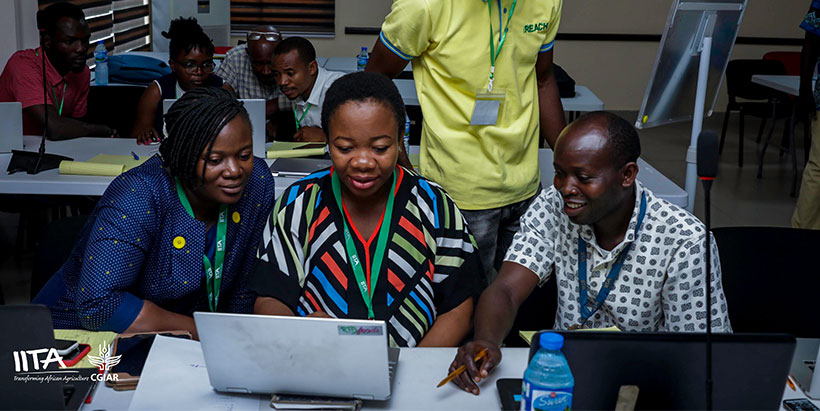
2691 final.docx Following a five-week online training on Cost Breeding, the IITA held a five-day in-person workshop to provide practical training to breeders on accurate costing of their breeding programs for optimal resource allocation. The workshop brought together participants from various units, including the IITA Finance Unit, six IITA breeding programs – cassava, maize, soybean, banana/plantain, yam & cowpea – and AfricaRice.
This initiative aims to enable breeding programs to track and manage their costs for improved efficiency while also establishing a link between cost management and the genetic gains the breeders are targeting.
The training is an initiative of the Genetic Innovation and Modern Breeding Project led by Senior Director for Plant Breeding and Pre-breeding within the One CGIAR, John Derera.
The meeting was organized by IITA’s Grain Crops Product Manager Dean Muungani, Yam Molecular Breeder Paterne Agre, and Cassava Project Administrative Officer Richard Ofei.
The IITA Director of West Africa Hub and Director for Crop Improvement, Michael Abberton, officially opened the workshop and highlighted the importance of the topic at hand. He acknowledged the timing of the training, given the challenges the breeders face in effectively managing their costs due to improper allocation of resources. He advised participants to maximize the workshop for the improvement of their programs.
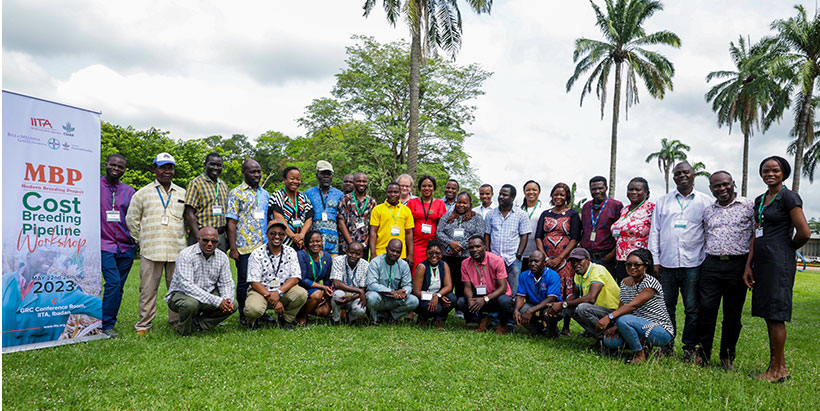
Breeding Optimization Specialist for CGIAR Excellence in Breeding, Lennin Musundire, who facilitated the training, held practical sessions with the participants on the use of the University of Queensland (UQ) costing tool for the cost breeding pipelines. He highlighted that in addition to accurately managing their costs, the training would assist breeders in writing funding proposals based on well-informed insights. This would avoid undervaluing or overvaluing their programs in terms of cost.
During the workshop, participants had various breakout sessions organized according to crop teams. These sessions provided practical exercises on the full costing of their programs, covering all stages from germplasm development to product registration.
Sharing their feedback, the participants expressed appreciation for the training’s valuable contribution to enhancing their breeding work. Although some participants suggested that additional time was required for practical exercises on how to master the use of the costing tool, others felt confident in utilizing the tool on their own.
One of the participants, Christabel Nachilima, a Soybean Research Associate from Zambia, shared her insights during the workshop. Having worked with the Soybean Breeding Program for the past 7 years, she observed that most of their activities lacked proper cost evaluation. “This training has helped us understand how to cost and place value on all our activities. It has been an amazing experience for me,” she said.
Another participant, Moruff Karem a Chartered Accountant with the IITA Finance Unit, emphasized the significance of the training from his perspective as a service provider to scientists. He noted that the training would help him offer well-informed and precise advice to scientists, particularly in the area of budgeting and resource allocation.
Musundire explained how the impact of the training would be measured, highlighting specific expectations. He said each participant is expected to acquire the proficiency to effectively utilize the UQ costing tool after the training.
In addition, he mentioned that participants should be capable to produce a comprehensive report on the accurate costing of their programs. Furthermore, he expressed the expectation that the participants would be equipped to train their partners, enabling them to make informed decisions regarding breeding program costing.
Speaking about future projections of the training, Muungani shared the plans of the organizing team to evaluate the level of acceptance of the costing tool among breeders. If the adoption rate falls below expectations, the team would assess the possible reasons behind it and determine appropriate measures for resolution. “In future, we will continue to assess the need for further training, and conduct additional workshops accordingly,” he said.
Contributed by: Daramola, Ochuwa Favour
Contributed by
Recent stories