IITA has named its research station in Kalambo, Democratic Republic of Congo, after former Nigerian President, Olusegun Obasanjo in an event that took place on 8 October.

The IITA Board of Trustees decided to name the station after Obasanjo in recognition of his contributions to agricultural research throughout Africa. This was also an acknowledgement of his sacrifices in DR Congo, made when he served as part of the UN troops mandated to bring peace to the country after independence in 1961.

Chief Obasanjo is also spearheading the “Zero Hunger Initiative” in Nigeria that IITA is helping to implement and which has strong relevance to DR Congo.

In his acceptance speech, Obasanjo appreciated DR Congo President Felix Tshisekedi for making it to the event and thanked IITA Director General, Dr Nteranya Sanginga and the BoT for the honor and for its tremendous work in the Institute. “I am honored to be associated with such a successful research initiative in Africa,” he said.

In front of the inauguration slab (L-R): President Felix Tshisekedi of DR Congo; Former President of Nigeria, Chief Olusegun Obasanjo; and IITA Director General, Dr Nteranya Sanginga.

In an exclusive interview with Radio IITA Senior Correspondent Dajie Odok, the honoree said he is glad to be back in the area for such a heart-warming event as he recalled the first time he had been in that country for a peace-keeping mission.

The research station, now called President Olusegun Obasanjo Research Campus, has been operational in DR Congo since 1974 as a project site. In 2011, the IITA BoT upgraded the site and made it a focal point of the Institute’s regional hub for natural resource management in the Great Lakes Region.

In his speech at the inauguration, Sanginga explained that the essence of establishing the research station is the dedication of IITA and its partners to the mission of fighting hunger and poverty in Africa, which would help boost agricultural productivity in DR Congo and the region.

He said the station is a symbol of IITA’s dedication and commitment towards building the research and development capacity in DR Congo and the Great Lakes Region.

He also reiterated the importance of research to agricultural transformation while citing the progress made by IITA and its partners.

Also speaking at the inauguration, DR Congo President Tshisekedi thanked Chief Obasanjo for “championing agriculture across Africa” and African Development Bank (AfDB) President, Dr Akinwumi Adesina, for his support to IITA, describing the initiative as an “obvious illustration of regional integration.”

He said AfDB is expected to fully play its role in helping DR Congo boost the capacity to process agricultural products through the industrialization plan he is rolling out. He also congratulated Sanginga for having established the IITA Kalambo station, with his personal means, pointing out that the facility is expected to build youth potential in agribusiness and help stimulate agricultural development in the region.

The newly inaugurated campus offers modern research facilities for impact-focused agricultural research for development, which includes a soil and plant analytical laboratory, a soil microbiology unit and molecular lab, a product and processing unit, and training facilities.

It also serves neighboring countries in the region including Burundi, Central African Republic, Republic of Congo, Rwanda, and Uganda.

Other dignitaries at the event include wife of the honoree, Mrs Bola Obasanjo; AGRA Chairman and former Ethiopian Prime Minister, Hailemariam Desalegn; Former and current Ministers and Government officials of DRC and other countries; World Bank Representative, Omar Lyasse; IITA Board Chair, Amos Namanga Ngongi; traditional chiefs; and others.
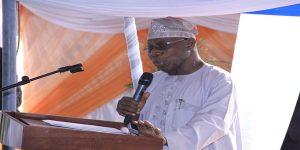
Former Nigerian President and IITA Goodwill Ambassador, Chief Olusegun Obasanjo has called for the adoption of agriculture as a business, which when implemented on an industrial scale will generate employment, especially among youth, as well as drastically reduce national food import bills. He made the remarks in Kalambo, Democratic Republic of Congo, during the inauguration of IITA’s research station, which was named after him.

Chief Obasanjo reminisced about being deployed to DR Congo 59 years ago as a young soldier with the United Nations Peacekeeping and noted with nostalgia how honored he was to be back and to have the campus named after him.

Chief Olusegun Obasanjo giving his remarks at the inauguration of the IITA campus in Kalambo.

He lauded IITA’s research and innovation in agribusiness stating, “I cannot be better honored than to be associated with the work and stations of IITA as a foremost agricultural research undertaking in Africa.”

“As the honorary ambassador of IITA,” he continued, “what makes me particularly happy is that the product of the research in this campus will soon be discharged all around in this country and in the adjoining countries.”

He spoke of the growth of the cassava value chain in Nigeria during his presidency and enjoined President Felix Tshisekedi of DR Congo to support IITA’s work to ensure such progress, and even more, is replicated in DRC. “When I became the President of Nigeria, we were producing 30 million metric tons. By the time I left, it moved to 50 million metric tons and there was no reason why we could not go on to reach 100 million metric tons.”

He noted there was room for more growth as cassava has gone from simply being a food crop to being used in industrial production of ethanol and other products.

He spoke of three other crops that he considered important cash crops namely, soybean, cowpea, and plantain/banana and noted that, “If we can be self-sufficient in them, I believe that we will drastically reduce the 50 billion dollars that we are spending every year in Africa to import food.”

In an exclusive interview with Radio IITA, Chief Obasanjo spoke of his love for agriculture, which he says, “I have been practicing very seriously for the last 40 years when I first left public office, and it is something that gives me joy.” However, he repeatedly advocates for the adoption of agriculture as a business and not just as a development issue.

“As a development project or program, agriculture is slow to address hitches but as a business, the planning and execution would be more urgent to achieve business goals”,. he said. To meet the food security needs of Africa now and in the future, particularly with the expected population explosion, this urgency needs to drive agriculture to the next level of productivity.

“Agriculture as a business will create employment especially among the youth, who need to start participating more in the sector to guarantee the commercial and nutrition stability of Africa in the present and in future.” According to Chief Obasanjo, it has been difficult to appeal to youth by treating agriculture as a development issue, but agribusiness stands a better chance of attracting young people, particularly the educated ones.

Chief Obasanjo’s final words at the inauguration focused on harnessing the human resources of Africa. He encouraged leaders to look out for competent Africans in diaspora and take advantage of their expertise for the benefit of African countries and the continent as a whole.

IITA GoSeed, a unit of the IITA Business Incubation Platform (BIP), is launching the first e-commerce website in Nigeria soon, making breeder and foundation seed of the best varieties of important food crops available. Buyers can now order online at www.iitagoseed.com.

IITA GoSeed is responsible for the commercial promotion of the early generation seed of improved crop varieties generated by IITA and other international (CGIAR) centers across the globe. Focus crops include banana and plantain, cassava, cowpea, maize, rice, soybean, and yam. IITA GoSeed produces and sells high quality breeder and foundation seed of these crops to seed producers in the seed system in Nigeria and across Africa at affordable prices. Working with seed experts, seed producers, seed regulators, and other stakeholders across the various value chains, IITA GoSeed ensures the movement of seed to farmers to help transform their productivity, income, and livelihoods.

Access to clean, improved varieties of seed is a major challenge to achieving high productivity and profitability in agricultural production in Africa. Improved seed varieties may be unavailable, sold at high prices, or sold in adulterated forms to smallholder farmers in rural areas, thereby promoting the use of farmer-saved seed. This has contributed to consistently low yields and poor income levels, increased rural poverty, and underdevelopment in the sector.

IITA GoSeed is passionate about improving farmers’ access to clean seed and creating a viable seed ecosystem in Nigeria and across Africa. This first e-commerce site for breeder and foundation seed of the best varieties in Nigeria will take away the headache of locating a source of quality seed, and the stress of traveling from one part of the country to another to purchase seed. Locations of IITA GoSeed  fields can be accessed on the Seed Tracker via the website. After ordering online, buyers have the option of pick-up or home delivery.

Visit the IITA GoSeed website at www.iitagoseed.com from 1 November to keep updated with relevant information about the seed system and agriculture in Nigeria and to place orders. For further enquiries and to learn more, contact info@iitagoseed.com or follow IITA GoSeed across these platforms:

Facebook: www.facebook.com/iitagoseedltd

Twitter: www.twitter.com/iitagosedltd

Instagram: www.instagram.com/iitagoseedltd

LinkedIn: https://www.linkedin.com/company/iitagoseedltd/

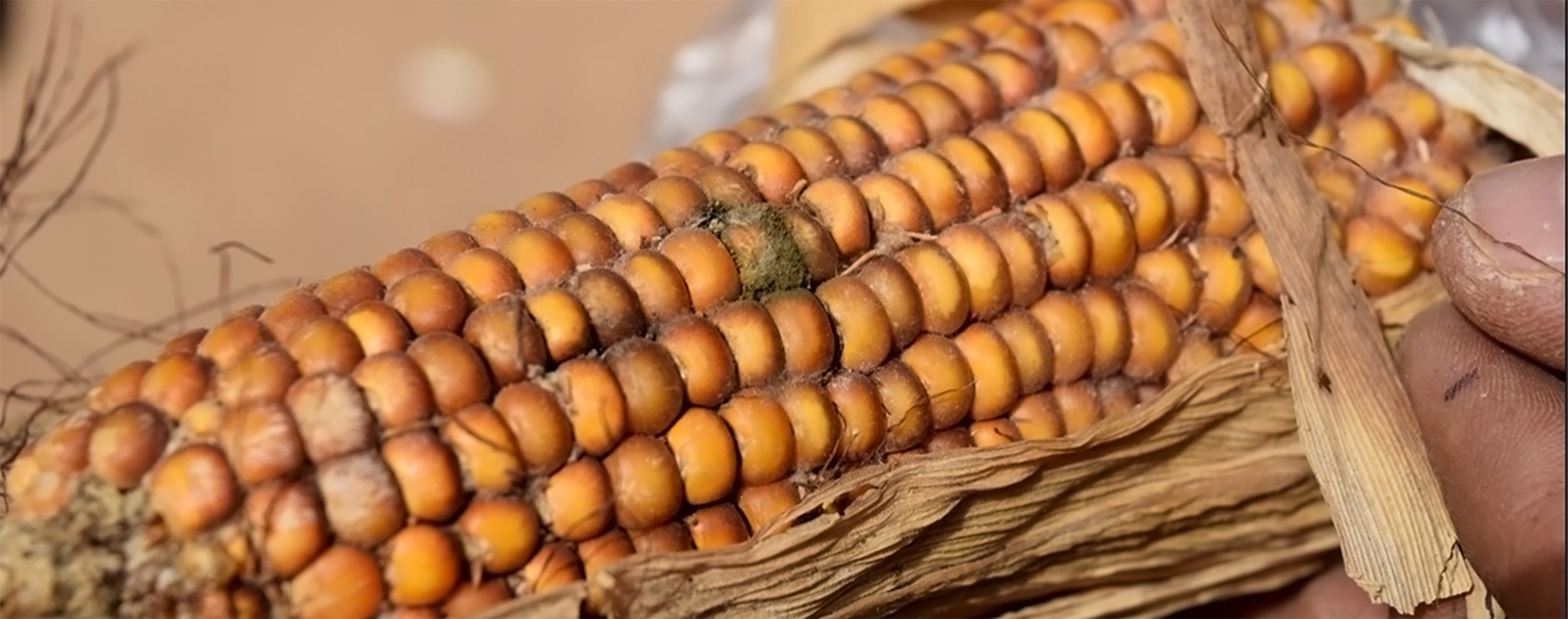
A study has identified the best non-toxic strains that can limit aflatoxin contamination in laboratory and field conditions. One of the authors, Dr. Alejandro Ortega-Beltran, a plant pathologist with the International Institute of Tropical Agriculture (IITA) says, “We were able to detect  non-toxic strains with the highest ability to limit crop contamination in the laboratory and the highest efficiency to prevent aflatoxin producers from reaching  treated crops.”

Ghanaian farmers can now control Aflatoxin, earn big
Maize contaminated by aflatoxin. When consumed, aflatoxin increases the risk of one developing liver cancer

The study, which was recently published (August 2019) in the Frontiers in Microbiology Journal has great public health implications for Ghanaian maize and groundnut farmers and consumers. As Ortega-Beltran adds, “We selected the eight most efficient strains to compose two Aflasafe products. These products are now registered with authorities in Ghana. Farmers can now apply Aflasafe in their fields which will enable them to produce maize and groundnuts that have low aflatoxin content. These safe crops can enter domestic and international premium markets.”

Aflatoxin is a major cause of ill health and lost trade opportunities in many African countries, including Ghana where solutions have been sought for decades. Consuming aflatoxin-contaminated food causes stunting in children and increases the risk of liver cancer in adults.

In Ghana, maize and groundnut are the crops with the highest aflatoxin levels. Government authorities have set the acceptable limit of aflatoxin at 15 parts per billion (bbp) for maize and 10 ppb for groundnut. However, levels over 50 ppb are a common occurrence.

Although aflatoxin can be controlled in farmers’ fields, Ghana has been focusing on postharvest interventions. This has not been effective in reducing aflatoxin levels in food because crop infection and contamination often begin in the field. Once crops are contaminated, aflatoxins cannot be completely removed.

Ghanaian farmers can now control Aflatoxin, earn big
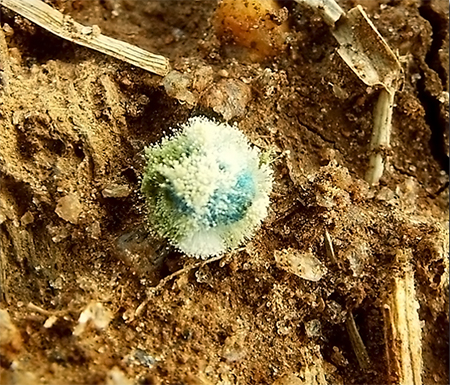
Aflasafe in the field. Aflasafe is IITA’s product which prevents aflatoxin-producing fungi from multiplying and contaminating crops

Since 2013, the use of non-toxic and natural biocontrol agents has been sought as an alternative for aflatoxin control in Ghana.  A group of researchers from the International Institute of Tropical Agriculture (IITA) and other agricultural institutes, led by Ranajit Bandyopadhyay, an IITA Principal Scientist (Plant Pathologist), carried out a study to detect the best non-toxic biocontrol agents for aflatoxin management in Ghana.

The study showed that substantial displacement of aflatoxin producers from soils and crops occurred in treated plots across the three agroecological zones where these strains were tested. The displacement was observed also in neighboring non-treated crops. Eight of the most superior strains were selected as active ingredients of two biocontrol products, each one containing four atoxigenic strains. This means that soon, Ghana will have two aflatoxin biocontrol products named Aflasafe GH01 and Aflasafe GH02.

Both of these Aflasafe products are a practical, efficient, and cost-effective tool to reduce aflatoxin contamination thus reducing aflatoxin-related diseases and increasing access to local and international premium markets seeking aflatoxin-compliant crops.

The research revealed that several atoxigenic A. flavus isolates are associated with both maize and groundnut grown across diverse agroecological zones in Ghana. However, the potential of atoxigenic isolates native to Ghana to competitively displace aflatoxin producers and limit aflatoxin content in the field has not been investigated.

The 2019 study examined the ability of 12 non-toxin producers to move from the soil to crops and limit aflatoxin contamination. The 12 isolates were chosen for testing if they were similar to the non-toxic biocontrol active ingredients already in use in other West African countries, and also if they were able to limit aflatoxin contamination in laboratory conditions.

Aflatoxins are produced by several fungi belonging to Aspergillus section Flavi which grow in soil and decaying vegetation and ultimately infect crop grains. However, the most common aflatoxin-producing species worldwide is Aspergillus flavus (A. flavus).

Atoxigenic biocontrol is already in use in Burkina Faso, the Gambia, Italy, Kenya, Nigeria, Senegal, Tanzania, and the US.

The IITA Forest Reserve is one of 27 sites designated as Important Bird and Biodiversity Areas (IBAs) in Nigeria. The 350-ha forest qualifies as an IBA because it holds 67 bird species that are restricted to the Guinea-Congo Forest Biome, and the entire IITA-Ibadan Campus, which consists of other habitat types, is a haven for birds as over 270 different species have so far been documented in the area. Apart from the ecosystem services these birds render, they also enhance ecotourism in the area—the campus remains one of the hotspots for bird watching in Nigeria.

Mist-nets are normally set up along existing trails to minimize disturbance.

With funding support from the A.G. Leventis Foundation and the Nigerian Conservation Foundation, the IITA Forest Center uses different census techniques, including line transect, point count, and mist-netting, to monitor these birds quarterly. The aim is to understand their populations and other life history parameters. Although each of these techniques is unique, mist-netting is exceptionally interesting, especially for nonprofessionals, as they would have the opportunity of holding the birds in their hands for better appreciation of their beautiful feathers. The third mist-netting session for 2019 took place 10-12 September between 6 am and 11 am, during which 41 birds, distributed across 10 species, were mist-netted.

Mainly conducted by experts, mist-netting is a technique used to capture wild birds for ringing or banding. The mist-nets, made of nylon or polyester mesh, are suspended between light-weight poles. When properly set up, the nets are virtually invisible to birds. As the birds are familiar with these routes, they enter the nets unknowingly and get trapped in the baggy pockets until they are carefully removed by an expert.

Explaining the process, Ornithologist and IITA Forest Center Manager Adewale Awoyemi said, “The safety of these birds is very important. We want to extract the birds from the nets, collect data, and release them back into the wild as healthy as possible. Therefore, if a bird starts struggling, we let it go.” Ideally, birds are checked for removal from the nets at 30-minute intervals. The nets are in various sizes, length, height, and mesh, depending on the specific bird species targeted for the survey.

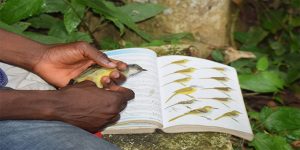
Field guides aid bird identification during ringing. Photo by A. Ajayi, IITA.

After extraction from the nets, they take the birds to the ringing station for identification, ringing, and data collection. With the help of field guides, the birds are identified to species level, after which a metal ring, containing coded identification numbers, is gently fitted on the tarsus with the aid of a special plier. The rings are in different sizes and are used, based on the size of the bird trapped.

Other morphometric data, such as wing, bill, head, and tarsus length, mass, breeding evidence (brood patch), age, moulting, and samples (blood, feather, and cloacal swabs), are also collected. This information, if collected systematically over a long period of time, can be used to unravel some aspects of bird ecology, physiology, behavior, and population structure.

A 3-day planning workshop for the Start Them Early Program (STEP) is ongoing at IITA Headquarters, Ibadan. The purpose of the workshop is to launch STEP and make plans for its operations in the next one year.

STEP is currently operating in Democratic Republic of Congo, Kenya, and Nigeria, with the vision of transforming African agriculture through partnerships with secondary schools. This initiative aims to transform the mindsets of young Africans from seeing agriculture as undesirable to seeing it as a viable source of income.

Jemimah Njuki, Senior Program Specialist in Canada’s International Development Research Center (IDRC), in her keynote address said, “This is the first time we have done something like this, and we hope that the vision is achieved.” Njuki also commended IITA for being committed to providing solutions to agricultural problems.

STEP aims to build the next generation of agribusiness leaders in Africa. The training in agribusiness will merge with school curriculum in the participating schools and be turned into a model for other schools to adopt.

Sanginga highlighted the mission of STEP and the commitment of IITA’s partners to the program. He spoke of the program’s prospects, saying “When next there is an evaluation, you will see all the changes that have been made. STEP will grow to become an institution on its own.”

So far, STEP has reached over 800 students in DRC where 33 pupil-initiated agribusinesses are thriving. Some are involved in rabbit farming, guinea pig breeding, poultry keeping, and vegetable production. School Managers are also involved in agricultural production, especially poultry and rabbit rearing to improve school incomes and pupils’ practical knowledge.

STEP focuses on helping young people to explore the various opportunities across the agricultural value chains. Participants at the workshop agreed that agriculture needs the involvement of young people who are “innovative and tech savvy” to achieve an economically stable and food secure future. In the same way, young people need agriculture to meet their personal goals and to sustain the family.

At the end, Sanginga advised all country representatives to be creative, hardworking, and strict with timelines, to achieve the goal of the program.

IITA participates in TICAD 7 in Japan
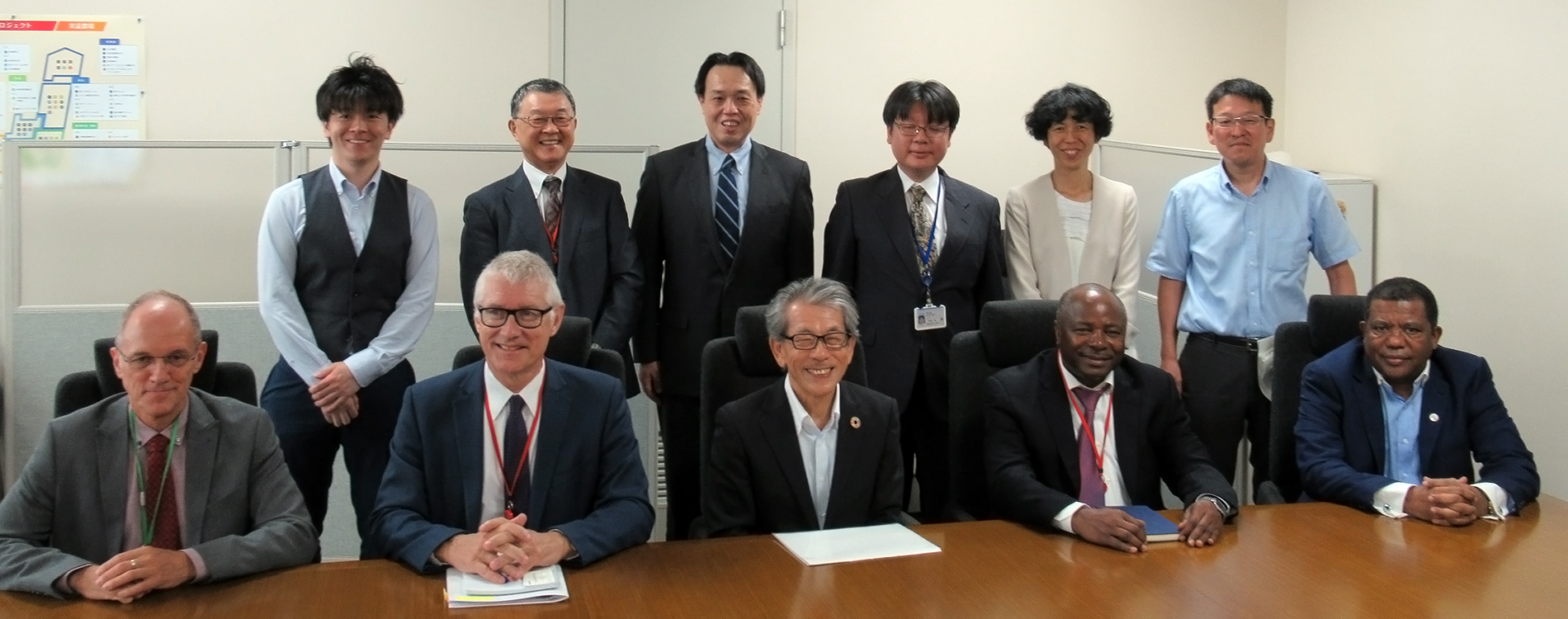
L-R (Front row): Dr Marco Wopereis, Director General, World Vegetable Center; Dr Matthew Morell, Director General, IRRI; Dr Masaru Iwanaga, President, JIRCAS; Dr Nteranya Sanginga, Director General, IITA; Dr Belay Begashaw, Director General, SDG C/A; (Back row) second left: Dr Shuichi Asanuma, IITA Board member; third left: Mr Yoshihisa Hishinuma, Director-General, Agriculture, Forestry Fisheries Research Council Secretariat, MAFF. Photo by AFFRC.

IITA Director General Nteranya Sanginga participated in The Seventh Tokyo International Conference on African Development (TICAD 7) on 28–29 August, held in Yokohama, Japan. The TICAD was launched in 1993 by the Government of Japan, to promote Africa’s development, peace and security, through the strengthening of relations in multilateral cooperation and partnership, particularly with the country. As part of the conference, the Ministry of Agriculture, Forestry, and Fisheries (MAFF) Japan and Japan International Research Center for Agricultural Sciences (JIRCAS) organized a special side event titled ‘Achieving African agricultural transformation for improved food and nutrition security’. During the event, DG Sanginga presented a keynote speech titled “The dissemination of research results is important for improving productivity and nutrition in Africa.”

In line with the event theme, ‘The Power of boosting Africa; for the future of food and agriculture,’ Sanginga explained the role of IITA in ensuring food security in Africa and gave an overview of the IITA Business Incubation Platform (BIP).

A team from the Agro-processing Productivity Enhancement and Livelihood Improvement Support (APPEALS) project’s National Coordinating Office (NCO) and Lagos Project Office, visited the IITA Headquarters in Ibadan on 28 August. The purpose of the visit was to explore possible areas of collaboration with IITA.

Kenton Dashiell discussing with Heather Akanni.

APPEALS is a project of the Federal Ministry of Agriculture funded by World Bank. It is a six-year project from 2016 to 2023 and currently operating in six states of Nigeria: Cross-River, Enugu, Kaduna, Kano, Kogi, and Lagos. The project has five components: Productivity enhancement, primary processing and value addition, technical support, project management, and infrastructure support to agribusiness.

The project aims to empower 60,000 people across the six states (10,000 from each state), particularly women and youth, and 5% for persons with disabilities and special needs. The APPEALS project is the only project presently handling empowerment of the disabled. APPEALS decided to work with IITA because, as a World Bank funded project, professionals are being engaged and IITA is recognized as having high professional standards in the agricultural sector.

Heather Akanni, the National Women and Youth Livelihood Specialist of APPEALS, who led the team said, “I was excited when I heard of IITA facilities such as the Business Incubation Platform and Youth in Agribusiness. We are looking at IITA assisting us with capacity building, financial support, and mentorship in helping the beneficiaries sustain the value chain they have chosen.”

Hassan Aliyu Hayat, Head Livelihood Development, APPEALS National Coordinating Office also said, “I believe if we partner with IITA, our beneficiaries will get the best.”

After a tour of IITA facilities and technologies, the team expressed their interest in partnering with IITA in areas such as Women and Youth Empowerment as well as technical support.

Kenton Dashiell, IITA Deputy Director General, Partnerships for Delivery expressed satisfaction with the idea of collaboration. “IITA will greatly like to partner with the APPEALS project. The youth program can tailor-make programs that suit your objectives,” he said.

The management of APPEALS confirmed it will meet to finalize the decision.