The IITA Southern Africa Hub marked International Women’s Day with vibrant celebrations across its stations, showcasing the pivotal role of women in shaping the future of agriculture.

In Malawi, the station organized a symbolic one-kilometer walk, echoing the year’s theme, “Invest in women: Accelerate progress.” The march resonated with the popular struggle signature tune “Tiyende pamodzi” (let’s walk together), famously associated with the late former President of Zambia, Kenneth Kaunda. Director of the Department of Agriculture Research Services, Dr Grace Kaudzu, joined the walk, commending IITA’s initiative and shared interest in formally participating in the next year’s celebration.
Women staff at the IITA Southern Africa Hub during the event.

In Mozambique, the Nampula station invited representatives from four institutions to participate in the celebration—Agronomic University Mussa Bin Bique with three women representatives (one teacher and two students), Agrotechnical Institute (ITPAM) with seven women representatives (two teachers and five students), Oruwera Partner (Seeds Production Company) with two women (the Director and the Administrator), and Mozambique Agricultural Research Institute (IIAM) with two interns.

IITA Country Representative Steve Boahen emphasized the importance of the day and encouraged women and students to explore various aspects of agriculture, including agribusiness and microbiology. He highlighted IITA’s commitment to promoting women’s prominence in available vacancies.

Director of Oruwera Company, Engr Emilia Chaimite, shared how the institution has provided job opportunities for women in various areas, leading to positive impacts. She mentioned cultural barriers as one of the challenges encountered in trying to empower women but expressed optimism for progress.

Dulce João, a Mussa Bin Bique University professor, stated that investing in women implies changing attitudes towards culture and customs, giving opportunities, and fighting for gender equality. “Investing in women is the same as investing in the future, and this will bring results that could change the world,” he said.

During the debate session moderated by Matina Felizardo Neves of IITA, Engr Chaimite highlighted the importance of understanding gender equality to avoid misunderstanding. She also emphasized the need for education to reach both men and women and achieve societal balance.

Women staff at IITA Malawi Station.

ITPAM professor Marta José emphasized the institution’s efforts to encourage women to continue studying agronomy, including providing facilities for paying tuition fees for mothers. An ITPAM student also encouraged women to believe in themselves and their potential, stating that only then would their value be seen.

The event concluded with participants touring IITA’s laboratory and the Institute’s field.

Contributed by Ochuwa Favour Daramola
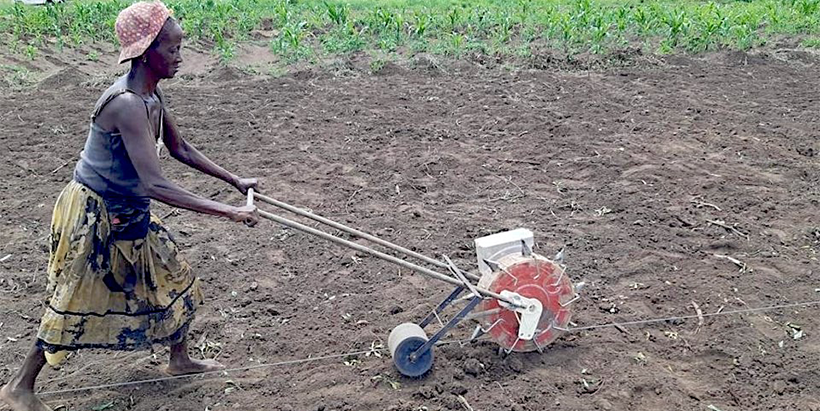
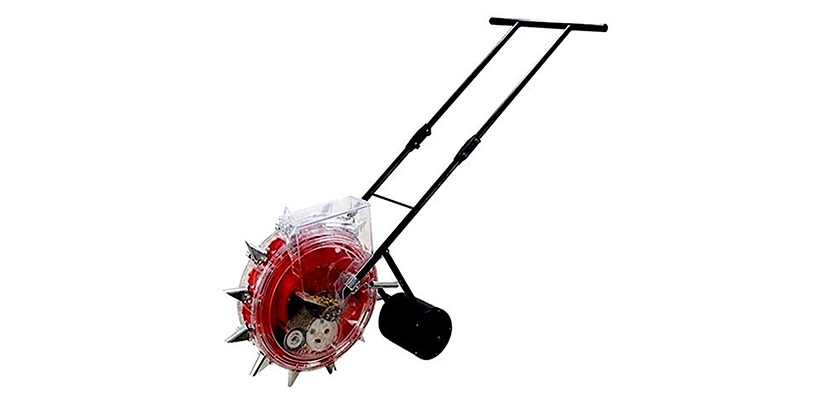
Mechanization has been recognized as an essential factor in agriculture development efforts to save on labor and time in many farming operations for smallholder farmers. In Mozambique, IITA conducted a study on a hand push manual seeder (HPMS), also known as the Legume Hand Push Manual Planter (LHPMP), to be used by farmers, particularly female farmers, in the establishment of common legume crops, including common beans, cowpea, groundnut, and soybean fields.

The introduction of the HPMS was a response to the competing demands of female farmers’ time during the planting season as they juggle fieldwork and caring for the family. As a result, women do not establish enough acreage of legumes and other crops. The lack of time also leads farmers to practice traditional farming of randomly planting seeds, leading to low or high unit spacing and dumping many seeds in a hole. Also, random planting causes difficulties in weeding, spraying, and harvesting, leading to poor yield.

A female farmer using the HPLS to plant Soybean.

The study noted that both male and female farmers were willing to use HPLS due to ease of use, simplicity, and versatility in planting a wide range of legumes and cereals. Other benefits of the equipment are that it can operate in various soil textures and weathers, is light, and consumes no fuel.

“The planter is attractive and easy to use and adapted to the planting of different seeds. The single-row, multi-crop planter is maintenance-free, except for two bearings that require regular lubrication to reduce the friction of the rotating drum. The farmers welcomed it eagerly,” says Canon Engoke, a Seed Systems Agronomist at IITA Mozambique and one of the researchers working on popularizing the planter.

HPLS equipment

The planter has proven its potential to save time and improve yield when following recommended line spacing and good agronomic practices. The study noted that the farmers use half the time and reduced costs when using HPLS for both cowpea and soybean compared to the hand hoe and rope line planting. As more women are involved in cowpea farming for food security, the equipment can save planting time, increase yields, and increase the number of female farmers in soybean production.

The amount of time saved with HPLS could be invested to increase production area for the same legume or diversify to others and complete demanding household chores without affecting crop production.

With all the benefits demonstrated by the planter, some farmers, especially the youth, have expressed an interest in purchasing several of them to offer planting services in communities at a more competitive fee than using the hoe in line spacing. This will create employment among female and youth farmers.

IITA has engaged some artisans to fabricate the HPLS in Mozambique to make it widely available. Innovations are under way to modify it into planting and marking the next line in one run, eliminating the need to use a rope and saving even more on costs and planting time.

IITA conducted theoretical and practical training sessions for farmers on the use of HPLS machines in demonstration cowpea and soybean fields in the Nampula and Zambezia provinces of Mozambique.

The research was supported by USAID Feed the Future Mozambique improved seeds for better Agriculture (SEMEAR) and Grain Legumes and Dryland Cereals (GLDC).

Food safety took a step forward in Mozambique as IITA signed a Technology Transfer and Licensing Agreement (TTLA) with AflaLivre Moçambique S.A. (AflaLivre) to manufacture and distribute Aflasafe in the country. The renewable agreement, signed on 7 May, defines the framework of operations and responsibilities of each party.

IITA’s Aflasafe team is already providing technical assistance with the design of the Aflasafe factory and procurement of the equipment. This Aflasafe manufacturing facility in Nampula, the fifth in sub-Saharan Africa, should be operational by June 2022.

IITA signs Aflasafe manufacturing and distribution agreement in Mozambique
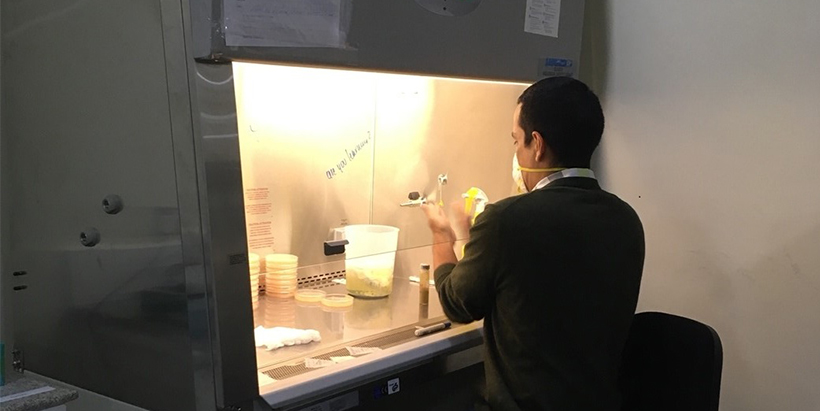
IITA Plant Pathologist Dr Alejandro Ortega-Beltran working on the inoculum to manufacture Aflasafe MZ02 in the Arusha factory.

Mozambique has the potential to contribute significantly to food security in Africa. However, only about 15% of its arable land is cultivated, mainly with staple food crops such as maize, cassava, and groundnut. Also, only about 20% of maize and groundnut produced in Mozambique enter markets; the rest is consumed at the household level. Moreover, high aflatoxin levels in these crops undermine their nutritional value and reduce access to lucrative export markets in the event of surplus production.

The country’s huge production potential and aflatoxin challenge led IITA and partners to develop and adapt the aflatoxin biocontrol technology for local use with funding from USAID. After several years, two Aflasafe products—Aflasafe MZMW01 and Aflasafe MZ02—that were developed with atoxigenic strains of Aspergillus flavus native to Mozambique and tested across the country were registered in February 2019 for commercial use by the Division of Registration and Control of Agrochemicals, in the Department of Plant Health under the National Directorate of Agriculture and Forestry in the Ministry of Agriculture and Food Safety. As a result, farmers in Mozambique now have an effective technology to address the aflatoxin menace.

IITA signs Aflasafe manufacturing and distribution agreement in Mozambique
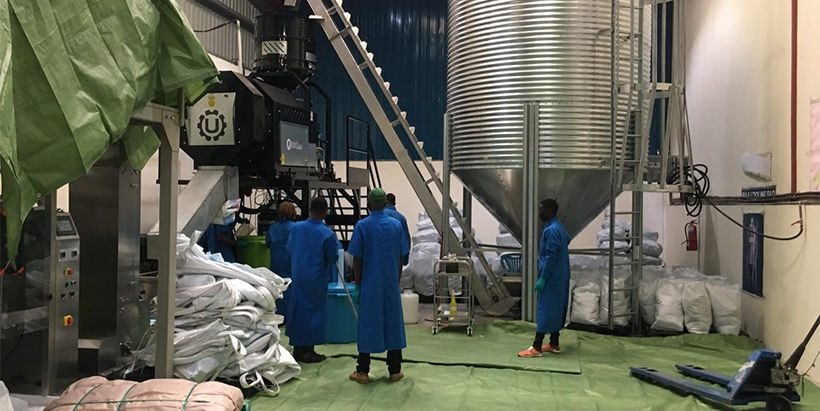
Manufacturing Aflasafe MZ02 in Arusha for Mozambican farmers’ use during the 2021 cropping season.

Groundnut growers, who had participated in the effectiveness trials of Aflasafe in Northern Mozambique, showed considerable interest in the product after seeing its tangible benefits in reducing aflatoxin accumulation. Therefore, to meet growing demand, IITA facilitated a short-term manufacturing arrangement for Aflasafe MZ02 at one of the operational licensed factories in the region.

Fifteen tons of the product were manufactured by A to Z Textiles Ltd, in Arusha (Tanzania), transported by road, and distributed by the Associação Moçambicana Para Promoção do Cooperativismo Moderno (AMPCM), a cooperative, facilitated by the Royal Norwegian Society for Development also known as Norges Vel, an international NGO.

IITA signs Aflasafe manufacturing and distribution agreement in Mozambique
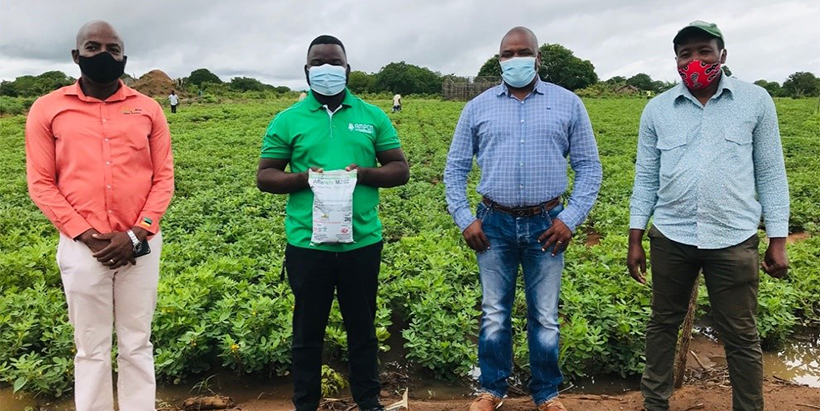
IITA Plant Pathologist and Mozambique Aflasafe Coordinator GNWG members and farmers in Mozambique in a groundnut field about to be treated with Aflasafe MZ02 produced in Arusha, late January 2021. Activities of the Aflasafe team continued despite the COVID-19 pandemic. Pictured from left to right are Rui Matos (Farmer of 23Matos company producing groundnuts), Natalino Barnete (AMPCM Manager and GNWG focal point), Joao Augusto (IITA Plant Pathologist and Mozambique Aflasafe Coordinator), and Ibraimo Chabite (Laboratory Director, University Lurio (Unilurio)).

Concurrently, discussions began with the groundnut working group to facilitate Aflasafe production in Mozambique and reduce the cost for local farmers, who have to pay more because of the import-related transactional costs, limiting widespread use. AMPCM and Norges Vel teamed up with a private company Miruku Agro Indústria (Miruku), to set up AflaLivre, a private limited liability company registered with the Legal Entities Conservatory of the Republic of Mozambique.

With Norges Vel as the majority shareholder, the core business of AflaLivre is to produce, distribute, and add value to groundnut, maize, cassava, and other agricultural products, process and manage agricultural inputs, including Aflasafe, and other agricultural-related matters.

Unlike other Aflasafe factories, this one will combine Aflasafe manufacturing and aflatoxin-safe groundnut processing in one facility. As a result, Mozambican farmers are now a step closer to having a reliable source of an aflatoxin biocontrol product at a significantly lower price than what it cost to import it from Tanzania.

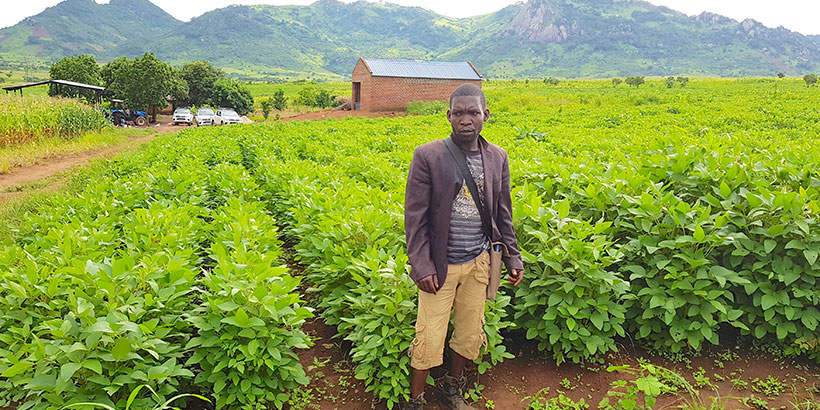
Members of the Dreamers Group in Zambezia province, Northern Mozambique, were smiling all the way to the bank in the just ended farming season, 2019/2020. This year they generated more than 2,277,000 MZN (US$31,625) from the production and sale of soybean and common bean seed and grain and vegetables.

Lourindo Jacinto Abel, the DG farm manager at the soybean farm.

Lourindo Jacinto Abel, the DG farm manager at the soybean farm.

The group, known as DG or just Dreamers for short, identified seed production as a very lucrative business. With support from the Improved Seeds for Better Agriculture project (SEMEAR) of Feed-the-Future Mozambique, they are now running a very successful venture on the production and commercialization of soybean and common bean certified seed.

The group ventured into the seed production business in the 2017/2018 cropping season by renting a farm in Murrimo, a community in Gurue District, Zambezia Province of Mozambique, to start seed production. SEMEAR trained the group on seed production and sold basic seed of soybean and common bean to them to start them off in certified seed production.

An overview of the DG’s farm.

The group started with a 10-ha field—7 ha for soybean and 3 ha for common bean certified seed. From this, they harvested 8.7 tons of certified soybean and 2.4 tons of common bean seed. These corresponded to 1.25 t/ha and 0.8 t/ha for soybean and common bean, respectively. SEMEAR also arranged with the Seed Inspection Unit for field inspection and certification of DG’s seeds.

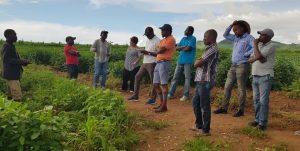
SEMEAR also supported DG in establishing demonstration fields/farmer field schools (FFS). Here, neighboring farmers learn best crop management practices, source quality seeds, and access affordable mechanization services to improve production and productivity to ensure food and nutrition security and generate income.

In the second year (2018/2019), DG extended their seed production by engaging five out-growers selected from well-skilled and knowledgeable farmers to produce seed with SEMEAR and DG’s technical support. They supplied them with the basic seed acquired from SEMEAR and provided technical assistance until field inspection and certification. The farmers took care of all crop management (weeding, pest control, harvesting, and bagging).

Ripping the farm for planting to ensure minimum soil disturbance as part of Conservation Agriculture.
Through rigorous best crop management practices, DG and its out-growers produced 10.5 tons soybean and 8 tons common bean certified seeds, and 7.5 tons of soybean grain. DG bought the certified seeds from out-growers at grain market price plus an additional 10 meticais per kilogram (US$0.13) if the farmers honored all their commitments stated in the memorandum of understanding signed between the out-growers and DG.

“It was a very good year. We managed to reach yields of 1.5 t/ha soybean and 1 t/ha common bean with the conditions we have. If farmers get these results, we can succeed in the development of the agriculture sector,” said DG Leader Anacleto Saint Mart.

They sold the bulk of the seeds produced to Sociedade de Beneficiamento de Sementes (SBS), an agro-dealer in Gurue, the district capital, and Phoenix Seeds Ltd, a seed Company in Manica Province. The rest they sold to farmers in the community at half the seed companies’ price.

SEMEAR project donor and team visiting of the DG farm.

DG also supported seed out-growers to establish demonstration fields where farmers can easily see the performance of the varieties and technologies they are promoting. DG provides land preparation (plowing and disc harrowing) and planting services.

Formed in 2016 by ten young men, the DG has continued to expand its operations, hiring staff and acquiring more land and equipment with their earnings.

“We at DG dream to become a center of knowledge where farmers will learn and share their experiences to improve productivity and production. We are happy with the current yields we are obtaining on our farms and the out-growers’ fields,” said Saint Mart.

The Government of the Kingdom of Eswatini, in collaboration with IITA, has launched a Food Composition Table and a National Recipe Book for foods commonly consumed in the southern African country. The ceremony to unveil the books took place in the legislative capital of Lobamba in October 2019.

Attendees with copies of the book.

Chief Research Officer at the Ministry of Agriculture, Similo Mavimbela, welcomed participants to the ceremony including senior Government officials and representatives from both local and international development partners such as the University of Eswatini, Eswatini Water and Agricultural Development Enterprise, the World Food Programme, World Health Organization, and IITA.

He noted that, as with many developing countries, the Kingdom of Eswatini did not have a Food Composition Table (EFCT) that would provide detailed food composition data (FCD) on the nutritionally important components of their foods. Neither had they formally documented their local recipes with the methods of preparation. While these were passed on informally in the past, it was essential to capture and preserve the traditional methods of food preparation for the next generation.

The implementation of the IITA-MIRACLE Project formed a foundation on which to build as it included a study on the Food Consumption and Dietary Intakes of women of childbearing age and children 6–59 months of age from households affected by HIV/AIDS. The project involved conducting a nutrition survey carried out in collaboration with the Eswatini Ministry of Agriculture and Ministry of Health. The survey collected information on the amounts and types of raw and cooked foods that people consumed and nutrient intake estimates at the chiefdom and regional levels.

Part of the output of the nutrition study was the compiled food composition table and the recipe book for commonly consumed foods in Eswatini.

In her remarks, Principal Home Economics Officer, Nikiwe Dlamini, briefly described the origins of the documentation project. She covered details of the study, including the target population, the coverage, the data collection process, and the involvement of communities in the development of the EFCT. The study included samples taken from six constituencies and seven chiefdoms spread across different regions of the country.

Participants, including Busie Maziya-Dixon (left) and David Chikoye (2nd left), listening to the official remarks by the Minister of Agriculture.
Members of the Technical Working Group (TWG) gave presentations outlining the process of developing both the EFCT and the recipe book. The TWG Leader, Phumzile Mdziniso and group member, Siniketiwe Zwane-Mdaka both acknowledged the contribution of IITA, and Senior Food and Nutrition Scientist, Busie Maziya-Dixon in particular.

Speaking on behalf of IITA, Director of Southern Africa Hub, David Chikoye congratulated the TWG for their hard work that had culminated in the launch of these two important compilations. He also commended the country for the development of such documents because appropriate nutrient intake and a quality diet are crucial for a healthy nation. He commended Maziya-Dixon and the IITA technical staff who provided backstopping during the implementation of the project for ensuring that the project was a success.

Under Secretary (PAD) of the Ministry of Agriculture, Mr Nkosinathi E. Mbingo presided over the official launch as a representative of the Minister of Agriculture, Hon. Jabulani Mabuza. He noted that the mandate of the Ministry of Agriculture was to ensure that Eswatini is food and nutrition secure and he expressed appreciation as this helps to achieve that goal. He said the compilation of the recipe book is crucial for the country to “preserve our traditional preparation methods for the future generation,” especially concerning indigenous foods.

IITA’s research in Mozambique has made much impact in rural and national development by ensuring that the agricultural sector is competitive, sustainable, gender-balanced, and resilient to the stress and impacts of climate change. IITA Seed System Agronomist, Canon Engoke, outlined the details at IITA-Nampula during a seminar titled “Agricultural technologies dem anded for change in Mozambique” on 14 May.

Mozambique farmers enjoy greater yields as a result of IITA’s research
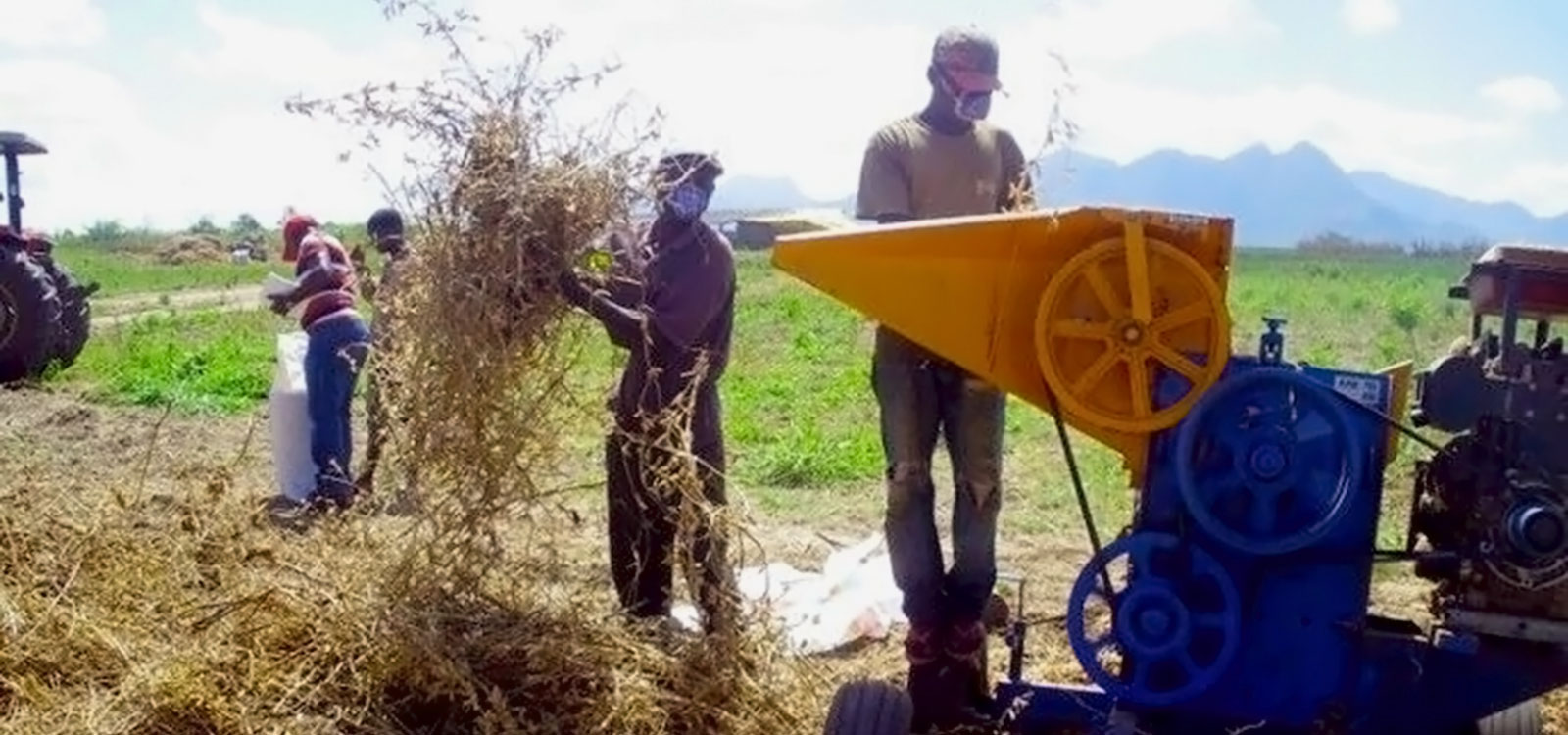
Shelling of soybean by farmers and field workers.

Mixed cropping systems characterize the agricultural production locations in the northern and central highl ands. These locations have continuously experienced declining and irregular distribution of rainfall coupled with incidences of drought. Other challenges of agricultural production in Mozambique include low soil fertility, over-reliance on rainfall, increasing susceptibility to pests and parasitic weeds, and poor farming practices (inferior varieties and technologies).

Despite these challenges, data indicates that IITA crop production in the region experienced a steady increase from 2002 to 2018.

Through research evidence and advocacy, changes have occurred over the last two years. Tested and existing technologies for crop yield improvement include use of inoculants, judicious application of phosphorus fertilizer, and system management such as crop rotation and intercropping. Some of the tested inoculants were imported from Brazil, Kenya, Malawi, South Africa, Zambia, and Zimbabwe.

The increase in gain on input/ha for the inoculant is attributed to improved capacity as well as adequate field management practices. IITA has played a key role in this by providing research-based information on the importance of using P fertilizer in soybean production.

Yields of farmers working with IITA on cowpea, sesame, and soybean have also shown a trend of increase over the last three years. Farmers’ field yields of cowpea, sesame, and soybean were 800, 500, and 1600 kg/ha, respectively, in the 2018 season.

Engoke noted “There is room for improvement through the use of several improved varieties and technologies developed by IITA for Mozambican agriculture. There is evidence that through research activities and interventions of IITA, the yield potential of these crops can be increased to 1500 kg/ha for cowpea, 5000 kg/ha for maize, 1000 kg/ha for sesame, and 3000 kg/ha for soybean.”

In furtherance of these, IITA scientists are working on trials to determine the best P fertilizer application rates across different agroecologies in Malawi, Mozambique, and Zambia. They expect to generate data on region-specific P application rates, which would be available to the public once the trials are complete.

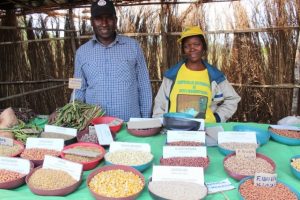
Américo Sisseque (local seed multiplier) and his wife trading
seeds at a Fair.

Project Manager for Feed the Future Mozambique Improved Seeds for Better Agriculture (SEMEAR) project, Carlos Malita, gave a presentation on 22 February at IITA-Nampula, Mozambique, in which he highlighted  the project’s achievements, prospects, future plans, and its contribution to economic development.

The contract review seminar titled “Formal & informal seed systems – one or another? Their roles in increasing access and use of improved crop varieties,” focused on the strategies that have been deployed to increase access and use of improved technologies for enhanced productivity and food security of rural households in the “Feed the Future Zone of Influence” (FTF ZOI) in Manica, Nampula, Tete, and Zambézia provinces.

Malita noted, “Despite technological improvement in the agriculture sector today, farmers still face a lot of challenges that include climate change, pests and diseases, high cost of certified seed, and inaccessibility of suitable seed (resistant/tolerant to pests, disease, drought).

“SEMEAR is catalyzing the informal seed systems, alongside improving and strengthening linkages with the formal seed system through capacity building, partnership, demand creation, seed production and distribution, technology use, and outreach,” he added.

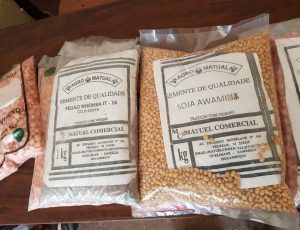
Certified seeds produced from SEMEAR improved varieties

Speaking on strategies for scaling seed systems, Malita said, “I am optimistic that if all these strategies are enhanced, farmers will have increased access to improved seed varieties which will in turn translate to the quantity of their crop yield and level of income.”

With the objective to increase production and distribution to reach 500,000 people (300,000 directly, 200,000 indirectly, and made up of 35% women), SEMEAR’s interventions pay attention to the roles of both formal and informal seed systems as important avenues for sustainable seed systems development.

SEMEAR relies on public–private partnerships to implement project activities like partnering with private seed companies, and with farmers, and developing informal seed system initiatives that will link with the formal systems for production and supply of improved seed to rural households. SEMEAR supplies early generation seed to its partners, provides business development services, and establishes functional linkages with seed authorities, buyers, and sellers while engaging partners in seed multiplication activities.

In the future, SEMEAR will continue pursuing activities aimed at improving both systems through development of partnerships with the public sector, private sector, community-based organizations, and other stakeholders, which have proven to be crucial for the sustainable improvement of the national seed systems.

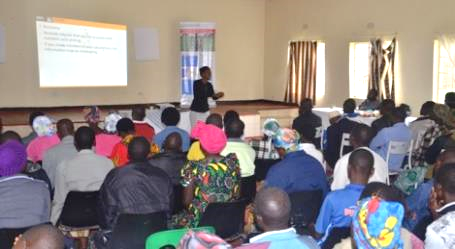
Formal training of stakeholders on best management practices.

After almost five years developing and field-testing an innovative but simple way to control aflatoxin in groundnut and maize  in Mozambique,  Mozambique’s Ministry of Agriculture and Food Security on 20 February approved the registration of two Aflasafe products.

Aflasafe is a 100% natural solution to aflatoxin contamination. Each product is composed of four native-to-Mozambique, non-poisonous types of the fungus Aspergillus flavus. Aflasafe controls the aflatoxins by outnumbering them. It is a case of sending a thief to catch a thief to get rid of toxic relatives, because the poisonous and non-poisonous fungi are kith and kin.

Muacheia Acacio Groundnut farmer applying Aflasafe in Muriaze, Nampula Province, Northern Mozambique, during field efficacy trials conducted during the 2016/2017 cropping season.

Muacheia Acacio Groundnut farmer applying Aflasafe in Muriaze, Nampula Province, Northern Mozambique, during field efficacy trials conducted during the 2016/2017 cropping season.

Aflatoxin contamination in maize and groundnut is widespread in Mozambique. This naturally occurring poison compromises public health and causes liver cancer. Child stunting and weakened immunity resulting in more illness have also been associated with aflatoxin. Economically, Mozambique’s re-entry into the lucrative groundnut export market has been compromised by aflatoxin.

The two registered products—Aflasafe MWMZ01 and Aflasafe MZ02—were first extensively tested in farmers’ fields in four main maize- and groundnut-growing areas in Central and Northern Mozambique, covering a swathe from low to high altitudes across 5 provinces and 22 districts. Results showed dramatically high aflatoxin reduction (by between 85 and 99%) for both groundnut and maize, compared to situations without Aflasafe.

Most importantly, nearly all (more than 90%) of the maize and groundnut harvested from Aflasafe-treated fields met the stringent European Union safety levels of 4 ppb maximum total aflatoxins for food destined for human consumption, this compared with only 49% in non-treated fields.

The five-year project was funded by USAID–Mozambique and the United States Department of Agriculture–Foreign Agricultural Service (USDA–FAS). The two products were developed by IITA in collaboration with USDA’s Agricultural Research Service, University of Arizona (USA), Mozambique National Agricultural Research Institute and Mozambique’s Ministry of Agriculture and Food Security.

Following Aflasafe registration, the Ministry of Agriculture and Food Security has asked IITA to organize awareness raising activities about aflatoxin issues as well as promote the use of Aflasafe in the country. These will include the organization of a workshop as soon as possible.

Several partners have already shown interest in manufacturing and commercializing Aflasafe in Mozambique. A very dynamic nationwide Groundnut Working Group comprising government and non-government actors including IITA has already pinpointed Aflasafe as its key strategy to control aflatoxin in groundnut. This heralds better times, and Mozambican farmers can look forward to safer food, better health, and profitable crops.

Mozambique is the 9th country where Aflasafe has been registered after Nigeria (2014), Kenya (2015), Senegal and The Gambia (both 2016), Burkina Faso (2017), and Ghana, Tanzania and Zambia (all 2018).

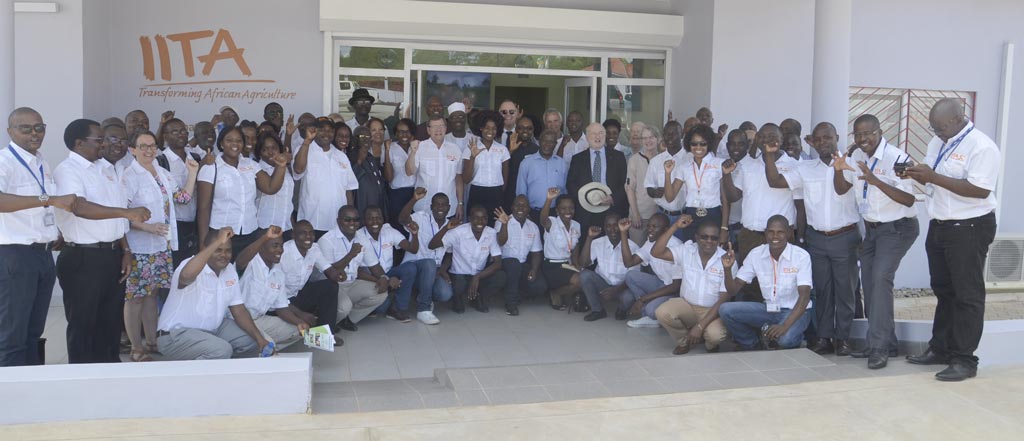
The Mozambican Minister of Agriculture and Food Security, Mr José Pacheco, and the IITA Board of Trustees (BoT) led the inauguration of the new offices of IITA in Nampula, Mozambique, last week, 8-12 May. The event also marked IITA’s golden jubilee celebration attended by IITA’s senior management team and the US Ambassador to Mozambique.

Picture of The board chair waters a tree as the US ambassador looks on.
The board chair waters a tree as the US ambassador looks on. Photo by C. Engoke, IITA

The BoT members were in Mozambique for their spring annual meeting, where among other things, Director General Nteranya Sanginga briefed them on the progress IITA has made since their last meeting in November last year, achievements, challenges, and investments. Tree planting by the IITA Board chair Bruce Coulman and the Minister of Agriculture, tour of the office facility, exhibitions, dancing, and a field visit were some of the activities that took place to mark the occasion.

IITA started work in Mozambique in 1988 with research focused on cassava breeding. It has now added soybean, cowpea, and sesame as the main crops being promoted in Southern Africa. A total investment of about US$800,000 has been made on the new facility that comprises 11 offices, three labs that deal with plant health, agronomy and soil fertility, and seed quality, an IT lab, seed storage facilities, and sample preparation area.

The station was officially opened in 2007 and as the number of staff grew, office space and other important research facilities became a major constraint. Management later approved a business proposal to source funds from within Mozambique and through cost recovery to assist in the construction of a new facility. IITA initiated several fund raising drives including production and sale of basic seed to different companies and farmers and consultancy services. So far, five varieties of soybean and four varieties of cowpeas have been officially registered in Mozambique. Mozambique has an acute shortage of basic seed and IITA is trying to address that challenge by working with Instituto de Investigação Agrária de Moçambique (IIAM), ICRISAT, CIAT, and other partners to meet the dem and for improved legume seeds. IITA Mozambique has access to over 155 hectares of l and, part of which could be used for seed production activities.

IITA is the only CGIAR center in Mozambique that has invested in facilities of high st andard. Sanginga described IITA-Mozambique efforts as ‘modest and honorable to the vision and targets of IITA’. He acknowledged the support provided by USAID and other partners to make this possible. To meet the gap and challenges that exist in Africa on seed supply there is a need for good quality seed and good storage facilities.

Briefing the board, the Minister, and dignitaries at the function, IITA Country Representative Steve Boahen explained that the yearly budget of IITA Mozambique has grown progressively from $417,000 in 2007 to $3.3 million in 2017. The station now has 6 international staff and 35 nationally recruited staff, and employs over 150 temporary workers during the growing season. The station has trained over 25,000 farmers and established about 150 hectares of disease-free cassava planting materials for distribution to farmers during the last six years. IITA Mozambique has also trained over 20,000 women on soybean home processing and utilization.

“The facility is a symbol of our commitment to the government of Mozambique, our colleagues at IIAM and partners to fight hunger and poverty in Mozambique. We are on the right path to transform African agriculture,” added Boahen in his address.

In Mozambique, IITA is operating in Nampula, Tete, Manica, and Zambezia provinces. Also present at the function was the Director of IIAM, Dr Olga Faftine. She acknowledged the support IITA is giving to IIAM with its research work and leadership in the field and particularly with the development of improved technologies for agriculture.

In his inaugural speech, Minister Pacheco called on more commercialization of soybean products emphasizing that farmers are struggling to get markets once they harvest. He commended the working relationship between IITA and the government and the contribution IITA has made to the agriculture sector in Mozambique. “I challenge IITA to increase production of seed to cater for the huge shortfall we have. The partnership with my ministry dates back to 15 years and the results are evident as we have gathered here.”

Picture of IITA staff in Mozambique  and the Board of Trustees celebrating the inauguration of the new offices  and IITA’s 50th year. Photo by E. Mwale, IITA.
IITA staff in Mozambique and the Board of Trustees celebrating the inauguration of the new offices and IITA’s 50th year. Photo by E. Mwale, IITA.

The United States Ambassador to Mozambique, Dean Pittman, said that because of the trust they have for IITA, they have made it possible to construct the seed store where quality control is assured. He also commended the great strides that have been made by IITA in aflatoxin control in maize and groundnuts. USAID under the Feed the Future is funding one of the biggest projects in Mozambique called SEMEAR. Under the project, IITA is expected to spearhead the production of over 3,555 tons of soybean, 1,234 tons of cowpea, and 582 tons of sesame improved seed varieties in a 5-year period.

Video links