The Program for Seed System Innovation for Vegetatively Propagated Crops in Africa (PROSSIVA) aims to support agricultural development by conducting innovative research to make the seed systems of banana, cassava, sweet potato, and yam more functional. As part of the project’s ongoing work, a team comprising members from IITA, Resourced, and SAHEL Consulting embarked on a learning visit to seed system stakeholders in Ghana from 21 February to 1 March. The mission was to understand the current context and develop seed system road maps for plantain and yam that align with PROSSIVA’s overall goal of creating and developing profitable and sustainable vegetatively propagated crop (VPC) seed systems.

PROSSIVA coordination team handing over the cleaned yam materials to SARI.

During the visit, there were strategic engagements with key partners of PROSSIVA, including the Crop Research Institute (CRI), Volta Mills and Allied Farms, Savanna Agricultural Research Institute (SARI), HIKMA Agro Services, Iribov West Africa Ltd, Plant Protection and Regulatory Services Directorate (PPRSD), seed entrepreneurs, and farmers. These stakeholders play a crucial role in the success of the project. The visiting team worked with all actors to craft robust seed system road maps for Ghana, integrating seed actors’ priorities, needs, and capacity in alignment with project objectives. The team examined the plantain and banana seed system landscape and identified priority areas for intervention toward developing a formal seed system, which currently does not exist for these crops. PROSSIVA will pilot rapid multiplication technologies while fostering linkages between research institutions, seed companies, and entrepreneurs to enhance the availability of high-quality planting materials. Activities such as conducting training sessions on propagation technologies and developing profitable business models will be undertaken to boost the demand for superior planting materials.

PROSSIVA will support partners in refining rapid multiplication technologies for the yam seed system to meet the escalating demand for high-quality mini tubers of preferred genotypes. Collaborative efforts with CRI, SARI, and the commercial seed companies will streamline production processes, ensuring timely access to clean early-generation seeds. A pivotal moment during the visit was the handover to SARI of 126 clean yam seed tubers of recently registered landraces, marking a significant stride towards improving farmers’ access to quality seeds of preferred varieties. The virus-free tubers will be multiplied by SARI to generate stocks for seed companies and entrepreneurs to produce certified seeds for farmers.

 Map of Ghana showing locations visited by the PROSSIVA coordination team.
Map of Ghana showing locations visited by the PROSSIVA coordination team.

Some challenges highlighted during the visit included the long time required to bulk up clean early-generation seed to meet the anticipated high demand and the limited public resource allocation for developing seed systems. It was also noted that succession planning is needed to ensure the continuity and efficacy of seed system operations at the research institutes. There is also a need to develop training manuals for seed production technologies, and production planning needs to be optimized.

In the future, the PROSSIVA team will work with partners in Ghana to align work plans and implement prioritized activities on the seed system roadmaps. As in other countries where PROSSIVA is being implemented, a key target will be to streamline seed production throughout the value chain, from the earliest stages of production by research stations down to last-mile production by community-based entrepreneurs. PROSSIVA reaffirms its dedication to driving impactful change within Ghana’s agricultural landscape by developing functional plantain and yam seed systems, which will boost incomes and food security in the country and profoundly impact the local community. This project has the potential to be scaled to other countries, further amplifying its significance.

Contributed by Delphine Amah and Olusola Bodunde

On 5 March, the Ruzizi Plain site of the Agenda for Agricultural Transformation in the Democratic Republic of Congo (ATA-DRC) program launched the harvest campaign for season A and crop season B.

The Minister of Agriculture, Fisheries and Livestock in South Kivu province, Jean Bosco Ruteye Kitambala, attended the launch as part of the realization of the Head of State’s vision to strengthen agricultural production above mining operations.

The program is run by the Ministry of Agriculture, with technical support from IITA, BAB, AALI, and other state institutions, including INERA, SENASEM, the Agriculture Inspectorate, and SNV.

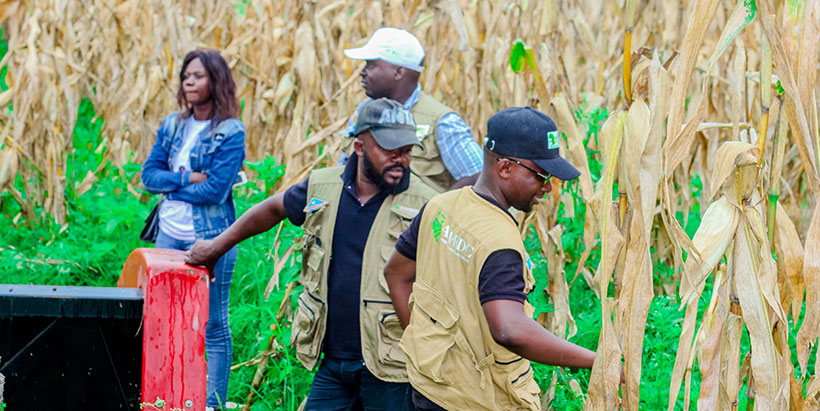
The maize field before the harvest.

In the Ruzizi Plain, in MATABA, this project has cultivated 30 ha of maize and 30 ha of soya, and other households in the Ruzizi Plain have benefited from fortified organic maize seed. They will return 10% of the harvest, which will be processed locally to provide the community with high-quality flour.

The community corn hybrid production field belonging to the Association for the Development and Promotion of Peace (ADPP) has been chosen as the pilot site for this activity.,

Participants in the field during the launch of the harvest season campaign.

Ruteye Kitambala said the initiative aims to improve household and local population income, increase farm household incomes, and significantly reduce food imports into the country. He expressed his satisfaction with the work accomplished by the government’s partners in this initiative.

ATA-DRC is currently being carried out in 4 pilot provinces, including Mongata in the city-province of Kinshasa, Nkuadi in KasaĂŻ Oriental, Nkudi in Central Congo, and Plaine de la Ruzizi in South Kivu.


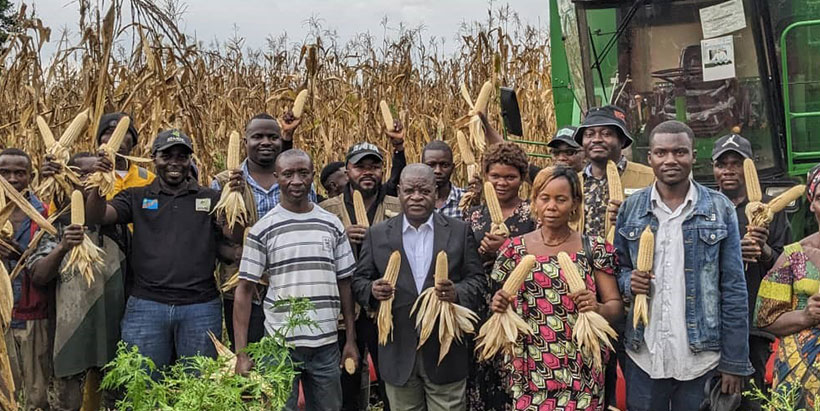
Farmers holding harvested maize cobs.

The program aims to prioritize agriculture over mining, aligning with the Head of State’s vision to transform agriculture into an economic powerhouse.

Contributed by Isabelle Buhoro

Achieving the gender equality commitment in agrifood systems would require deliberate and bold actions to accelerate progress, especially by investing significantly beyond the gender statistics towards building more inclusive transformative interventions to realize the Sustainable Development Goal (SDG) 5.

The group of participants attending the validation workshop in Kasulu district council

Such ambitions are being seized through the Muhogo Bora (MB) project, a gender-responsive cassava seed system in Tanzania with targeted outreach in the Western Zone aimed at ensuring that women, youth, and marginalized rural farmers from geographically underserved regions participate and benefit as cassava seed entrepreneurs (CSEs).

To achieve this goal, the MB project gender team conducted a co-creation study in March 2023: Exploratory participatory action research (PAR) on the gender-based constraints and opportunities for women’s and youth participation and benefit as CSEs in Tanzania. The team later organized validation workshops on the 15 and 18 May 2023 in Kasulu Town Council (TC) and Urambo District Council (DC) in Kigoma and Tabora regions of the Western Zone of Tanzania to share the emergent study findings for feedback provision and validation of the proposed potential gender transformative interventions by a diverse group of stakeholders.

IITA gender researcher Millicent Liani informed the participants that the project would integrate gender-responsive and gender-transformative approaches to enhance the equitable participation of women, youth, and marginalized rural farmers as CSEs. She stated, “In the MB project’s first 2021 recruitment cycle, which was informed by the set criteria by the BEST cassava project in Tanzania, there were very few women and youth as trained CSEs, with men accounting for 65% of CSEs with older men at 58% and male youth at 6%; while women were 35%, 25% being older women while 10% were young women.”

The  BEST cassava gender research study in Tanzania highlights the barriers to women’s low participation based on the project set criteria for CSE recruitment, including the availability to land, financial resources, the proximity of the land to the road, training interest and business acumen, and record-keeping skills. These reasons were approved by the local government authorities (LGAs) as a true reflection of challenges facing CSEs in Tanzania’s Western Zone, for which modified CSE selection criteria were then developed and implemented during the second 2022 recruitment cycle, increasing the total number of women and youth by 67%, from 111 CSEs in MB project.

Liani emphasized the need to go beyond reaching an equal number of women, men, and youth CSEs towards empowering women and youth CSEs while addressing the underlying causes of inequalities. “Reaching women does not ensure that they will benefit from a project or be empowered by it,” she said.

To address this, the Muhogo Bora project adopted PAR methods to facilitate ten co-creation discussions with CSEs and community leaders across two districts in Kigoma and Tabora Regions. The priorities to be tackled included the lack of land for women and youth, gender and youth discrimination, women and youth poverty, and cassava production and marketing challenges. The identified solutions included transformative interventions that create awareness of human and land rights and the importance of making joint decisions on family income, which could be achieved by using community dialogues, theaters, and local radio stations. They also highlighted the need to establish CSE associations for affordable credit provision and building youth capacities to operate agribusinesses. Local collaborators to support such interventions through a community-led bottom-up approach were proposed.

Gabriel Bisangwa, a cassava farmer from Kasulu TC, confirmed that the findings presented correctly reflected the co-creation discussions held during the gender study and further urged the government to act on the recommendations. “The local government authorities, through village leadership, can give opportunities to the survey participants to share the knowledge they gained from the study with their communities,” he said.

Bisangwa also noted that the co-creation approaches that the gender researcher used in the study are not familiar in the community. He suggested that religious groups be used to disseminate more information on gender and social inclusion according to their beliefs.

An influential community leader and farmer, Mariam Mwale, noted the importance of conducting more gender studies because many more challenges still hinder women’s engagement in development. “Many women belong in situations they are in because they do not have opportunities to engage in social discussions, but with such studies, women can open up and express what happens in the communities, and men agree to the discussion and become influencers to fellow men,” she explained.

Participants developing transformative action plans to solve the key priority problems identified during the gender study in Tabora Town Council

The workshop participants also discussed and validated the priority problems and developed transformative action plans to solve them. They also shared experiences on gender-related issues with real scenarios from the gender desks and community development officials.

The Muhogo Bora is a three-year project executed by Cornell University College of Agriculture and Life Sciences and implemented by IITA-CGIAR, Tanzania Agricultural Research Institute (TARI), and the LGAs in Tanzania.

Contributed by Gloriana Ndibalema

Morufat Balogun is Tissue Culture Specialist of the Yam Improvement for Income and Food Security in West Africa (YIIFSWA) project based in Ibadan, Nigeria, working on the development of technologies for high ratio propagation of high quality breeder and foundation seed yam. She has a Bachelor of Technology, Pure & Applied Biology, from Ladoke Akintola University if Technology (LAUTECH, 1996), MSc in Crop Protection and Environmental Biology (Genetics), University of Ibadan (1999), and a PhD, Plant Genetics, University of Ibadan (2005).

She is a senior lecturer (geneticist) at the University of Ibadan, since 2009 and visiting scientist at IITA since 2012. She had also served as a fellow for the United Nations University/Institute for Natural Resources in Africa (2000); IITA, Ibadan, Nigeria (2000-2005); Norman E. Borlaug International Science and Technology Fellowship for Women in Science, United States Department of Agriculture (2005).

She is currently mentoring PhD, MSc, and BSc students and a mentor under the African Women in Agricultural Research and Development Programme. She is a member of the Genetics Society of Nigeria and the Society for In vitro Biology and also won grants from the State department, USAID, USDA, and the MacArthur Foundation.

James Legg is a plant virologist at IITA, with more than 20 years experience of working on plant viruses and their insect vectors.

James graduated in Pure and Applied Biology from St. Catherine’s College, University of Oxford, before completing M.Sc. and Ph.D. studies at the University of Reading. James’ Ph.D. research examined the role of the whitefly, Bemisia tabaci in vectoring cassava mosaic geminiviruses in East Africa. Most of James’ professional career has focused on strengthening underst anding of cassava viruses, and using that improved underst anding to develop and facilitate the promotion of control strategies.

An extensive research portfolio has been developed covering aspects, such as, detection and molecular characterization of cassava viruses; field epidemiology; virus-vector interactions; development and deployment of host plant resistance; field surveillance strategies; vector molecular characterization, vector population dynamics/bionomics; vector-natural enemy interactions, biological control; and cultural approaches for the management of both viruses and their vectors.

James has published widely in peer-reviewed journals and has also contributed extensively to the development of training materials in various media formats, including video.

He has worked closely with a wide range of national and regional research institutions, as well as donor organizations, in developing research for development programs in sub-Saharan Africa. The most recent experience has been with USAID-funded programs and the Bill & Melinda Gates Foundation’s Great Lakes Cassava Initiative (GLCI).