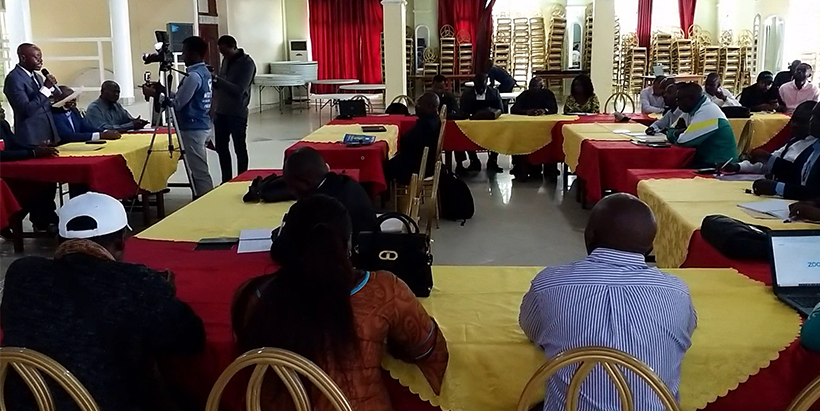
On 7 November, IITA signed an agreement with the Ministry of Agriculture and Food in Gabon to provide Technical Assistance to the Graine Phase 1 Support Project (PAPG1). The ceremony was presided over by Ndoutoumou Charles Theodore, Cabinet Director of the Minister of Agriculture and Food, representing the minister.

Cabinet Director of the Minister of Agriculture, Ndoutoumou Charles Theodore, addressing participants at the signing ceremony.

IITA Central Africa Hub Director Zoumana Bamba represented the Institute at the ceremony. He was accompanied by Deputy Director Komi Fiaboe and IITA Specialists Apollin Fotso Kuate and Rachel Zozo.

IITA’s technical assistance to the PAPG1 project is based on two main axes: seed system and capacity building. For the seed system, IITA is expected to provide 5 million healthy cassava cuttings and 667 thousand plantain tissue culture plants to the Gabon government. In turn, they will multiply these seeds further through SociĂ©tĂ© de Transformation Agricole et de DĂ©veloppement Rural (SOTRADER), a national structure promoting annual crops for further multiplication and distribution to the farmers by December 2023.

IITA CAH Director Zoumana Bamba (left)and the Cabinet Director Ndoutoumou Charles Theodore presenting the signed agreement.

Proven technologies such as semi-autotrophic hydroponic (SAH) propagation will be established at the national agriculture and forest research institute IRAF (Institut de Recherches Agronomiques et ForestiĂšres) and the national institute for agriculture and biotechnology INSAB (Institut National SupĂ©rieur d’Agronomie et de Biotechnologies).

Capacity-building activities will be organized for field technicians, and scientific collaboration with IRAF scientists will be established to select and evaluate new cassava varieties, among others.

Members of the IITA and Government of Gabon teams at the signing ceremony.

IITA has always wanted to establish a partnership with the Gabonese government to strengthen the capacities of researchers. IITA will provide technical support and advice in areas such as improving the seed system, integrated soil fertility management, integrated pest and disease management, improving the technical route for multiple food and commercial crops, and postharvest management and product processing. Several missions have been conducted since 2018 with the Gabon authorities, particularly the TAAT mission conducted in July 2021, which initiated the agreement that was signed. The present agreement marks the concretization of these efforts and represents a significant cornerstone in the partnership between IITA and the Gabon Government.

In his speech, the Director of the Cabinet emphasized the high trust bestowed on this partnership by the Gabon Government to transform agriculture and decrease dependency on food importation.

Contributed by Dr Apollin Fotso

IITA Director General Dr Nteranya Sanginga has been appointed as interim Chairman of the Democratic Republic of Congo (DRC) and Nigeria Business Forum by President Félix-Antoine Tshisekedi Tshilombo of the DRC. This platform creates a Chamber of Commerce between the two countries.

IITA Director General Dr Nteranya Sanginga is the interim Chairman of the Democratic Republic of Congo (DRC) and Nigeria Business Forum.

This title was granted to him during the last meeting of the Makutano forum hosted by the presidency of the Republic, during which President Tshisekedi welcomed the former President of Nigeria, Chief Olusegun Obasanjo, with business people ready to invest in the DRC in general and in the agro-food sector.

The Makutano Forum is a pan-African exchange meeting organized yearly in DRC since 2015. The objective is to promote the potential wealth that African countries have in general and DRC and develop Africa. The founder of The Makutano Forum is Mrs Nicole Sulu from DRC.

Furthermore, during this forum, the Kaduna State Governor, Mallam Nasir El-Rufai, will serve as the Interim Deputy President, while Pacific Kahasha and Ambassador Leke Adebiyi will be Interim Secretary and Interim Deputy Secretary, respectively.

DG Sanginga thanked the President of the DRC, Tshisekedi, and “Baba” Obasanjo for this appointment and argued that: “Agricultural activity should be considered as a commercial activity and non-social
the government should support agricultural entrepreneurship.”

The Democratic Republic of Congo could be considered a global food solution country capable of feeding approximately 2 billion people worldwide. It has a surface area of 2,345,410 km2 and potential such as 80 million ha of arable land, 4 million ha of irrigable land (of which only 1% is cultivated), 4 million head of cattle, and a fishing density estimated at 700,000 tons of fish per year.

Contributed by MichĂšle Kimpwene

IITACGIAR has partnered with the Ministry of Agriculture and Rural Development (MINADER) and the Food and Agricultural Organization (FAO) to release the Fall armyworm (FAW) egg parasitoid Telenomus remus in West Cameroon. The collaborators have been developing innovations to manage FAW in Cameroon.

FAO partner observing FAW egg parasitoids in vials ready for release in the field.

Through the One CGIAR’s Plant Health Initiative (PHI), the IITA-Cameroon IPM team, led by Komi Fiaboe, has identified several FAW natural enemies under the humid tropical forest and Sudano-Sahelian agroecologies of Cameroon. They established that the egg parasitoid Telonomus remus was the most aggressive, frequent, and widely distributed in farmer fields. Through joint funding of PHI and the FAO-funded Integrated Management Strategy for the Fall armyworm in Central Africa project, the parasitoid was collected from fields and mass-produced in the IITA Cameroon Entomology Laboratory under the leadership of IITA researcher Samuel Nanga Nanga.

Farmers in Bangante receiving explanation on biological control strategy and the negative effects of chemical control.

The current release aims to promote conservative and augmentative biological control in a small-scale maize production system. The first batch of 45,000 T. remus individuals was released from 3 to 5 October in Bangangte, Dschang, and Foumbot in the West Region of Cameroon by IITA researcher Albert  Abang, in collaboration with Nguelo Collins from MINADER and Jeannette Florence Magni from FAO.

Farmers participate in pre-release evaluation and search for Fall armyworm eggs in maize in Sangwa village in Bantoum, a locality in the Nde division, West region of Cameroon.

The release was witnessed by nine FAO and MINADER field trainers (seven men and two women) and 42 farmers (12 women). Forty-two farmers (30 men and 12 women) were trained on conserving natural enemies in the maize production system and on the ecosystem services rendered by those invisible friends. Specifically, farmers learned to identify FAW egg batches, differentiate the characteristics of parasitized eggs from non-parasitized ones, and recognize the

IITA researcher and farmer releasing parasitoids in Tsinbing village, Dschang subdivision of West region Cameroon.

presence of natural enemies and the detrimental effect of broad-spectrum

pesticides on natural enemies.

The second release round will be conducted in the cropping season, and a similar release exercise is planned for the Centre Region of Cameroon. Post-release surveys will also be carried out to assess the improvement of egg parasitism rates. According to Abang, this release, the first of its kind in the Central Africa region, is expected to create awareness of conservative biological control of major pests in the maize production systems among farmers and extension officers.

Contributed by Dr Komi Fiaboe

Within the framework of the ATAC and the Development of Commercial Agriculture projects, funded respectively by the African Development Bank (AfDB) and the World Bank in Congo Brazzaville, 12 officers from the ministry of agriculture, the National Research Institute (IRA), the National Center for Improved Seed (CNSA) and the National Center for the Management of Crop Diseases (CNLMC) were trained across four IITA stations in DR Congo, Nigeria, Tanzania, and Zambia, with the objective to strengthen the capacity of the Agricultural Officers so that they could train others in their home country, the Republic of Congo.

Visiting a cassava multiplication site in DR Congo.

The workshops in DR Congo, Nigeria, and Zambia covered various themes and incorporated presentations and interactive discussions. The trainees were familiarized with sustainable seed systems to raise awareness on seed quality, explaining different approaches to produce cassava planting materials, maize and soybean seeds, and the integrated management of seed multiplication fields. They also received practical instruction on operationalizing seed certification standards, including quality declared seed (SQD), protocols, and quality control mechanisms. Additionally, participants visited fields where maize, soybean, and cassava planting materials for the ATAC/PRODIVAC project would be sourced for introduction to Congo-Brazzaville for multiplication.

The Congolese trainees at an IITA-Tanzania laboratory.

In Tanzania, participants were trained in cassava pest and disease diagnostics in both the field and lab and in methods to improve the quality of cassava seed systems. They learned about cassava pests and diseases, how to identify their symptoms, and the damage they cause in the field. The trainees learned how to apply digital tools in the field to identify pest and disease damage, the laboratory methods for detecting and identifying cassava viruses and their whitefly vector and the methods applied at country level to strengthen cassava seed systems.

Taining participants, during a field visit in Zambia.
Training participants, during a field visit in Zambia.

By the end of the training, the field and classroom tests demonstrated that the trainees had absorbed a large amount of new information. Trainees expressed their enthusiasm for the training provided and were keen to continue to interact with the team of trainers. The capacity-building initiative also required follow-up training to be conducted locally in the Republic of Congo to ensure that the training elements were being implemented and reinforced.

Contributed by Dr Apollin Fotso

Food processors in Libreville, Gabon, recently participated in a training on the use of provitamin A rich plantain flour to alleviate Vitamin A deficiency in vulnerable groups. IITA-Cameroon Visiting Scientist Apollin Fotso Kuate led the workshop, which took place on 30 September under the framework of the project—Enhancing nutritional quality of plantain food products through improved access to endophyte primed and high provitamin A plantain cultivars under integrated soil fertility management practices in Nigeria, Cameroon and Gabon. Forty-one participants (30 men and 11 women) from the National Consultation of Producers of Gabon (CNOP-GA), researchers from IRAF, WAVE program, and the Gabonese Food Security Agency attended the training under the plantain project funded by the European Union through the African Union.

Workshop participants with facilitators at the food processors' training in Libreville, Gabon.
Workshop participants with facilitators at the food processors’ training in Libreville, Gabon.

The workshop’s first module focused on the provitamin A content of the plantain varieties found in Gabon, following analyses of green and unripe plantain samples. The second module focused on vitamin A sources and risk factors for vitamin A deficiency in the vulnerable group, particularly in children under five years of age, as well as post-harvest plantain management, promotion of plantain-based composite flour, the basics of food processing, and sun drying.

The training course was dynamic and based on the contributions and needs of each participant. Discussions during the training provided these participants with an in-depth knowledge of plantain flour production and its application as a substitute for wheat flour in various foods. As the pre- and post-test questionnaires were used to assess the basic knowledge of these participants, the result showed that their knowledge of plantain, post-harvest technology, and food processing increased by about 80% after the training.

IITA Scientist Apollin Fotso Kuate speaking with the media during the training.

Speaking at the end of the training, the representative of the farmers’ organization, Phil Philo, said the training allowed the participants to know about the plantain flour that can reduce dependency on wheat flour. He believes there are opportunities to develop the banana value chain in Gabon.

The IITA-led project is implemented in collaboration with Gabon’s Institute of Agronomic and Forestry Research (IRAF/CENAREST), Nigeria’s National Horticultural Research Institute (NIHORT), and Cameroon’s University of Buea. The project’s goal is to sustainably enhance the adoption, productivity, and utilization of endophyte-primed high provitamin A plantains cultivars and hybrids in the context of integrated soil fertility management in smallholder farms in Nigeria, Cameroon, and Gabon.

Contributed by Dr Apollin Fotso

Stakeholders in the Democratic Republic of Congo (DRC) organized a workshop to analyze the results of studies on the cassava and maize seed sectors. The workshop, under the Strengthening the Supply of Improved Seeds in Central Africa (SISCA) Regional Project, took place in Goma, on August 29 and 30, in the province of North Kivu.

Participants at the SISCA and PADRIR meeting hosted at IITA
Participants at the SISCA and PADRIR meeting hosted at IITA.

Based on the studies’ conclusions, the workshop recommended:

  • The establishment of a public−private partnership model in the seed sector.
  • The designing of the seed traceability model.
  • The revitalization of a consultation framework called the Provincial Council on Seeds (COPROSEM) to be developed in Goma, bringing together leading players in the seed sector (60% for the private sector, 40% for the public sector). The relevant branches will be established in all provinces of the country.
  • The set up of a competitive and accessible seed market, with seeds of available varieties adapted to the farming environment and valued by farmers.

IITACGIAR also hosted a meeting between SISCA and the Support Program for Inclusive and Resilient Rural Development (PADRIR), all funded by IFAD, to finalize the Framework and the Harmonization Protocol relating to joint activities between both parties.

Contributed by MichĂšle Kimpwene

His Excellency Gabriel Mbairobe, Hon Minister of Agriculture and Rural Development (MINADER) from the Republic of Cameroon, visited IITA headquarters on 14 September. His visit aimed to strengthen collaboration with the Institute, mainly to increase the production of cassava, which is in high demand in Cameroon. He also discussed finding a solution to the cassava root disease in the country.

Hon. Mbairobe meeting with the IITA Management team.

During a meeting with the Minister, IITA Deputy Director General, Corporate Services, Hilde Koper, highlighted the activities of IITA in various hubs. She also mentioned the agreement IITA has had with Cameroon for about 33 years, stating that the Cameroon Ministry of Agriculture is the main funder for this collaboration. “The government gave us land for research, and we have also had lots of projects from your Ministry. We are grateful,” she said.

IITA-West Africa Director Michael Abberton affirmed this statement while speaking about IITA’s activities in the various stations in Nigeria. He praised Hon Mbairobe for being a great champion of IITA in Cameroon.

Chrys Akem, Coordinator, TAAT Program Management Unit, spoke about the projects in Cameroon and mentioned the challenges affecting one of the ENABLE Youth Cameroon (EYC) projects. He appealed to the Minister to assist in resolving these challenges for the smooth running of the project. He also appreciated the Minister and the Cameroon government for trusting IITA to handle projects in the country. “Thanks for the collaboration,” he added.


The Minister visiting the Semi-Autoropic Hydroponic (SAH) green house.

Komi Fiaboe, IITA Senior Scientist and Officer in Charge of IITA Cameroon Station, thanked the Minister for visiting on such short notice. He also highlighted the richness of human capacity in agricultural research and transformation at the headquarters that could join forces with the IITA Cameroon team to support MINADER.

Hon Mbairobe expressed joy at finally being able to visit the IITA headquarters. He stated that the Cameroon government trusts IITA’s research and is satisfied with the Institute’s work in Cameroon. “We work with the IITA-Cameroon team on soybean and potato and wish to have a seed farm to demonstrate the excellence of IITA planting materials. But I also want to see what the headquarters does with cassava and how we can collaborate on that to reduce the importation of wheat in our country,” he said.

Following the meeting, Hon Mbairobe went on a tour of the Institute, visiting the Virology Laboratory, Genetic Resources Center (GRC), Semi-Autotropic Hydroponics (SAH), Cassava Processing and Mechanization Center, and the Youth in Agribusiness Center. After the tour, he shared his interest in working with the Virology, GRC, SAH, and Cassava Mechanization teams. He added that there would be follow-up discussions with the IITA team by the Department of Quality Regulation and Quarantine in the Cameroon Ministry of Agriculture.

Contributed by Ochuwa Favour Daramola

IITACGIAR in Rwanda contributes to agriculture technology through innovation generation in its work to improve crop varieties and strengthen the seed system of the country.

Farmer Promoter diagnosing a farm with the BXW App.

In conjunction with other national partners in Rwanda, IITA-CGIAR has developed and released six improved cassava varieties that are resistant to two viral diseases—Cassava Brown Streak Disease (CBSD) and Cassava Mosaic Disease (CMD). The Institute has also facilitated the establishment of cassava clean seed systems to support the Rwanda Agriculture and Animal Resources Development Board (RAB).

In collaboration with private seed businesses, quality cassava seeds are increasingly becoming accessible and available to cassava farmers in the country. The partnership with RAB has also contributed to the review of the cassava seed standards and quality regulations.

The High Quality Cassava Peel (HQCP) mash is a research innovation with increasing adoption in Rwanda.

The development of the ICT-based tool, BXW App, has helped smallholder banana farmers get early warnings of the Banana Xanthomonas wilt (BXW) disease; they are in a better position to take timely action to control the disease.

The BXW App also provides advisory services to the farmers, helping them address the far-reaching consequences of the bacterial disease for the individual farmers and Rwanda’s collective food and nutritional security.

With over 7,800 farmers registered on the App, and more than 378,700 farmers with access to banana agronomy and BXW management information, this cutting-edge tool is being integrated into Rwanda’s public extension system.

The development of a mobile digital system by IITA-CGIAR’s researchers gives Rwandans access to information on diet quality. The system has been deployed to about 400,000 Rwandans and provides relevant, scalable, and transferable intelligence to increase understanding of the regional and seasonal dynamics of diet quality across Rwanda.

This system also serves as a compass for policymakers in the health and agricultural sectors in formulating improved policies and interventions.

Students and interns learning at the office as part of IITA's capacity development mandate.
Students and interns learning at the office as part of IITA’s capacity development mandate.

In the area of biocircular economy, IITA-CGIAR is leveraging private sector partnerships to assess the value of organic waste in Rwanda. This focuses on four primary areas—organic waste composting, breeding Black Soldier Fly (BSF) larvae, small-scale cassava peel processing, and treating human waste. The partnership converts these resources into value-added products for sustainable development.

IITA-CGIAR contributes immensely to transforming and strengthening Rwanda’s agricultural sector through institutional innovations, policy engagement, capacity development, and partnerships.

Contributed by Timilehin Osunde and Tolulope Akinola

The IITACGIAR Projet IntĂ©grĂ© des Grand Lacs (PICAGL) participated in the agricultural fair organized from 29 to 31 August in Luhwindja, Mwenga territory in South Kivu, by the Agro Pastoral Cooperative for the Self-Promotion of Women at the Base [la CoopĂ©rative Agro Pastorale Ă  l’Autopromotion de la Femme Ă  la base (CAPAFB)].

Fair participants examining NABANA cassava roots and stem-cuttings.

The fair, themed “Promotion and sale of improved products and seeds”, aimed to popularize agricultural activities, technologies, and practices on a large scale.

The improved cassava variety NABANA, provided to farmers within the PICAGL framework, thanks to World Bank’s financing through the DRC government, was the focal showcase of the fair by producer associations of Luhwindja. The exhibition also included value-added products derived from NABANA by the IITA Youth team.

The farmers from Luhwindja, through CAPAFB, have benefited from 30 thousand meters of cassava cuttings that can cover 12 to 15 hectares of field.

IITA partnership officer (South-Kivu), Francine Nsindabagoma, represented IITA at the fair.

NABANA, developed with the National Institute for Agronomic Studies and Research (INERA), has been certified and included in the national catalog of seeds. It is a variety tolerant to diseases such as cassava brown streak and mosaic as well as pests. NABANA also has a high yield potential, with sensory characteristics highly appreciated for its leaves and roots. This variety contributes to the increase of agricultural production for a very fertile soil (25 tons/hectare), better than the old varieties cultivated by agricultural households.

Contributed by MichĂšle Kimpwene