
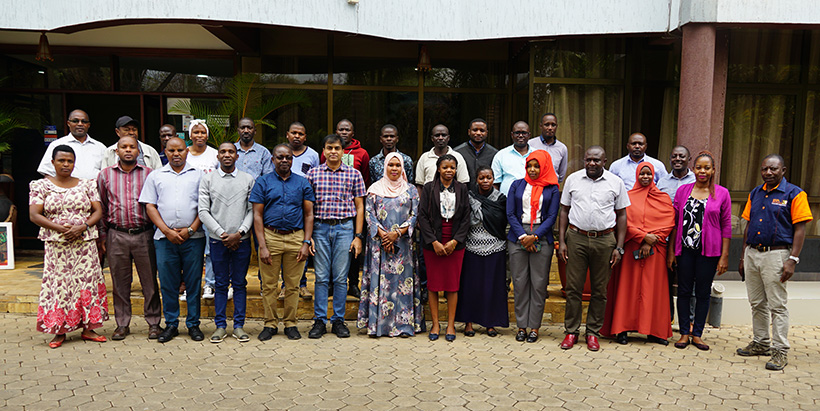
As part of efforts to curb the spread of the invasive Banana Bunchy Top disease (BBTD) in Tanzania, IITA–CGIAR, in partnership with the Tanzanian Plant Health and Pesticide Authority (TPHPA) and Tanzania Agriculture Research Institute (TARI), convened a three-day workshop in November to train targeted key officials in the ministry of agriculture tasked with responding to emerging threats, farmers, and private sector companies promoting the banana industry in the country. The workshop was held at Panama Garden Resort in Moshi.
The objective of the training was to provide information on surveillance and eradication techniques to be used in destroying virus-infected plants on farms and outline plans for countrywide surveillance for precise mapping of disease status in the country. The workshop also provided crucial information for developing a robust disease management plan. “Urgent actions are needed to delimit the extent of disease spread and create awareness so that appropriate measures are taken to contain the disease,” commented IITA Senior Plant Pathologist George Mahuku.
“If left unchecked, the disease will continue to spread and eventually reach the major banana-producing regions with grave consequences for food security and livelihoods of banana-dependent families,” Mahuku added.
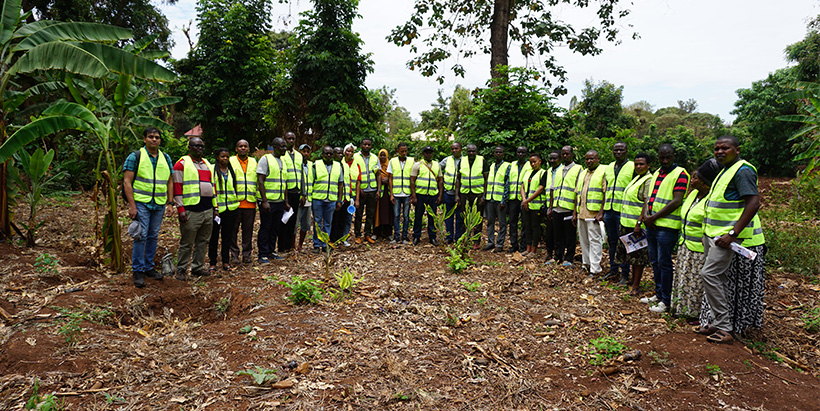
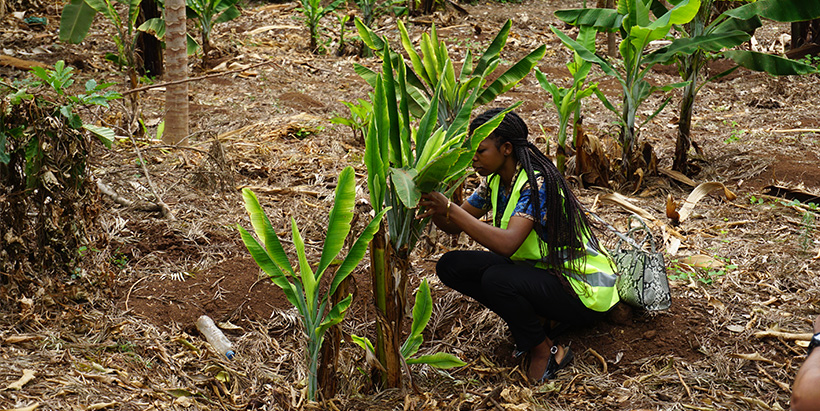
During the workshop, the team provided information, building on the Alliance for BBTV Control in Africa for surveillance and eradication techniques to be used and mooted for the destruction of virus-infected plants in the farms, and rapid countrywide surveillance for precise mapping of disease status in the country, crucial for developing a robust disease management plan. In addition, farmers and stakeholders participated in a hands-on session for the proper and effective destruction of infected mats meant to contain disease spread.
“Vigilance and preemptive action to destroy BBTV-infected banana plants, enhanced surveillance and monitoring strategies, improved capacities to recognize the disease, and the deployment of BBTV eradication teams to prevent infection and further disease spread are necessary to contain the disease,” said IITA Virologist and Head of Germplasm Health Unit, Lava Kumar. Kumar commended the sensitization of farmers and stakeholders for reporting and combating the diseases early, with the help of local and regional extension officers. Systems should be established to supply clean planting material to farmers who have destroyed infected plants to safeguard and sustain production.
“Lack of awareness of the disease among the community exacerbates the situation. Farmers use seemingly healthy planting materials from infected mats and, in the process, are helping the disease spread. Therefore, it is important to create awareness of the disease and curb its spread,” stated Hamady Lyimo of the TPHPA.
Banana bunchy top disease (BBTD) caused by the Banana bunchy top virus (BBTV) continues to spread in Tanzania. First confirmed in 2020 in Tanzania’s Kigoma region, the virus has reached epidemic levels in the Buhigwe district in Kigoma. The virus infection results in severe stunting and complete loss of fruit production. The infected plants remain as a vestige in the field and eventually die due to extreme stress.
BBTV spreads through the vegetative propagation of banana and by the aphid, Pentalonia nigronervosa, which is known to occur in all the banana-producing regions. Lack of awareness about the new disease among farmers and the nature of the virus disguised early detection of the disease. Surveys conducted in 2022, including alerts to report fields with suspect BBTD symptoms, have revealed that the disease continues to spread.
BBTV occurrence has been confirmed in Dar es Salaam, Kilimanjaro, Mwanza, Pwani, and Rukwa. If unchecked, the virus could spread to all the banana-growing regions. It could lead to severe losses worth several million US$, besides loss of livelihoods and household incomes for millions of banana growers. In the affected areas, banana production has been severely affected, leading to shortages and a spike in banana prices. In Buhigwe district, the price of a banana bunch has gone up from 10,000 Tsh to 30,000 Tsh due to BBTV.
As part of the CGIAR Plant Health Initiative, the IITA team is working with local partners to contain the spread of BBTV and recover banana production.
Contributed by George Mahuku (g.mahuku@cgiar.org) and Lava Kumar (L.kumar@cgiar.org)
Contributed by
Recent stories