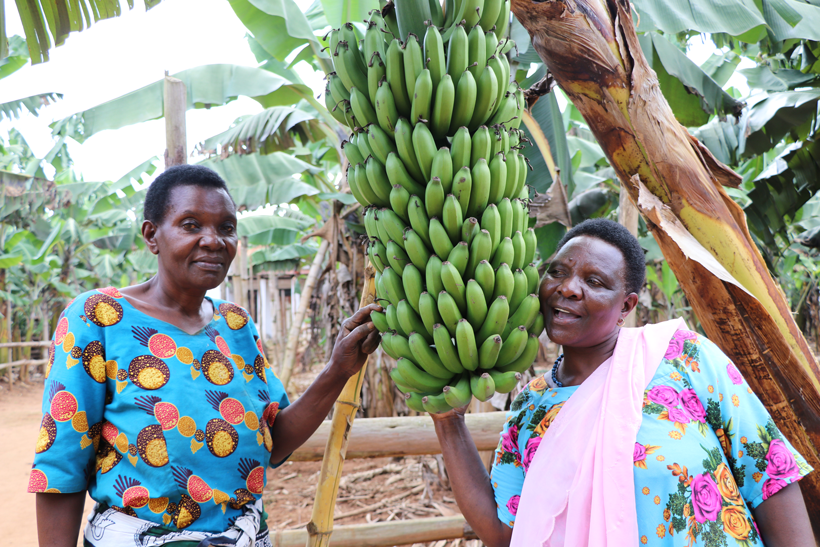
Tanzania is the second-largest banana producer in Eastern Africa, after Uganda. Kagera is the leading banana-producing region in the country, accounting for over half of the country’s banana production. Most banana varieties in Kagera are Highland Cooking bananas, commonly known as matooke, next to beer bananas and some dessert bananas. Smallholder farmers in the region have been highly vulnerable to food and income insecurity for decades, as all varieties are susceptible to major diseases and pests that cause significant yield losses.
Smallholder farmers, governmental and non-governmental organizations have made efforts to address the disease and pest challenges by introducing, propagating, and disseminating new varieties known as “Superior Banana Varieties” (SBVs), including FHIA hybrids and exotic landraces. However, adequate, systematic, and organized information on the uptake, adoption rates, determinants of adoption, and socioeconomic impacts was lacking, causing difficulty in determining the socioeconomic success of banana improvement initiatives and planning future interventions with new matooke hybrids.

In 2024, the agricultural economists and banana experts from the International Institute of Tropical Agriculture (IITA) explored the adoption and impact of SBVs in that region. Its results were bundled in a study entitled “Adoption and Impact of Superior Banana Varieties in Kagera, Tanzania: A guide for future distribution of banana breakthrough products”. It was concluded that the adoption rate of SBVs was 48% two decades after the first intervention.
The study found that the adoption rate was higher among male-headed households, where 48% of the sample households adopted SBVs in 2024, with 25% having adopted FHIA 17, followed by FHIA 23 (7%), and FHIA 25 (4%). The study noted farmers’ preferred traits and adoption criteria include tolerance to diseases and pests, adaptability to poor soil conditions, minimal organic fertilizer requirements, high yields (large fingers and bunches), better quality for juice and brewing, multi-purpose use for cooking, dessert, and roasting, and strong marketability.
“The farmers preferred FHIA 17 and FHIA 23 varieties for cooking and dessert, while for beverage making, Yangambi KM 5 and FHIA 25 were selected,” explains Dr Arega Alene, the Agricultural Economist at IITA.
The adoption of SBVs led to more households becoming self-sufficient in banana production, consuming and selling more bananas, and becoming more food secure. “On the other hand, the study showed that in households that adopted SBVs, women are more likely to be engaged in making decisions on sales than in households that have not adopted the varieties,” adds Dr Shiferaw Feleke, the lead of the study.
Moreover, the study revealed that the adoption of banana hybrids has increased productivity by 15% in Kagera by 2024, contributing nearly US$7 million worth of bananas to the region’s economy. This will generate more tax revenue due to increased trade volume and value in fresh and processed banana products.
These findings indicate that Kagera’s banana sector is undergoing a change, with improved varieties now recognized as key to long-term resilience and growth. It also shows that farmers are willing to add improved varieties even if they are quite different from the Highland Cooking bananas, which are a staple food. The strong interest from farmers reflects the success of past efforts to involve farmers from the very beginning in sensory evaluation of new varieties from breeding programs and promotion of SBVs through on-farm testing.
This highlights the need for increasing investments in banana research and scaling of the resulting innovations to address a broader range of production constraints and raise banana yields. “This is the first time that a study with new banana varieties has been conducted, revealing such a large impact,” Rony Swennen, IITA Banana Breeder, explains. Results and responses from farmers serve as a guide on how to spread the next wave of bananas, which are matooke hybrids released by TARI in 2021.
Contributed by Gloriana Ndibalema