In less than six years, IITA–CGIAR has developed and released 26 high-quality yam varieties across Africa, with 10 of these varieties released in Nigeria, the largest yam-producing country on the continent. Introducing these new varieties can potentially rejuvenate the declining yam value chain.
Training ABUAD farm staff
IITA has had a significant impact through its outreach, capacity development, and empowerment initiatives. Farmers across 15 states within Nigeria have gained access to the newly released yam varieties and received training on seed production technologies and good agronomic practices (GAP) for efficient yam farming.
Building on these achievements, the extension of genetic gains has expanded beyond farmer groups to institutions. Through the Yam Improvement Program, IITA has established a Demand Creation Trial (DCT) at Afe Babalola University (ABUAD) Farms. Afe Babalola University, along with its affiliated ABUAD farms and Afe Babalola Industries, has been introduced to four of the yam varieties released by IITA, which include Vayam and Akuabata (water yams), Favourite, Super, and Asiedu (Guinea yams), possess the necessary qualities to be processed into different yam products.
Training ABUAD farm staff and students on yam minisetts.
Seed yam tuber production is crucial for food tuber production for industrial use. Over ten thousand minisetts and minitubers for seed yam production were established by IITA-YIP for ABUAD to promote yam and yam products. The five yam varieties (Vayam, Akuabata, Asiedu, Favourite, and Super) have been cultivated at ABUAD farms, offering potential benefits to yam farmers in Ekiti State and its environs as multiplicating efforts are sustained to achieve commercial status.
The IITA-RTB Yam team also conducted training sessions for the staff and students of ABUAD farms on yam minisetts and Semi-Autotrophic Hydroponics (SAH). The participants showed keen interest in the training, recognizing its potential to help them manage the farm effectively to achieve desired results.
The positive testimonials from students indicated they had gained valuable knowledge and insights into yam techniques. The trained students now view yam farming, especially seed yam production, as a promising and profitable business opportunity that could be explored to improve their livelihoods.
Contributed by Onasanya Emmanuel
Over 70 IITA staff met in Malawi to strategize and plan to respond to challenges undermining the transformation of agrifood systems in Southern Africa. Southern African countries did not receive adequate rains in 2023/24 production systems and harvested below average yield, constraining household purchasing capacity and causing high levels of poverty and food insecurity.
Participants at the strategy development retreat.
The week-long retreat, with the theme ‘Thriving together,’ brought participants from Angola, Malawi, Mozambique, and Zambia who form the IITA Southern Africa Research and Administration Hub (SARAH). The primary goal of the retreat was to finalize the hub’s strategy framework while fostering team connections through team-building activities and a town hall meeting.
In his opening remarks, SARAH Director David Chikoye emphasized the need for the refreshed IITA 2024-2030 strategy to be result-oriented and fully aligned with partners’ research and development agenda. The refreshed IITA research strategy aims to effectively deliver innovations that will transform African agricultural food systems. He also stated that the hub research portfolio must be well-defined and aligned to national and regional agricultural needs and priorities.
“We have enormous challenges in Southern Africa that require expertise and scientific infrastructure. We are happy that IITA is investing in our hub infrastructure and empowering farmers with new innovations. We want the new strategy to speak to the needs of our farmers while we thrive together to drive agriculture innovations in Africa,” Chikoye said.
Among other activities, the retreat reviewed relevant national and regional frameworks and strategies to give context to the institute’s work in the region, analyzed future trends affecting the transformation of agriculture, and reviewed the lessons learned while implementing our 2012 – 2022 strategy to identify strategic implications and the rationale for the new plan for African agricultural transformation in the region.
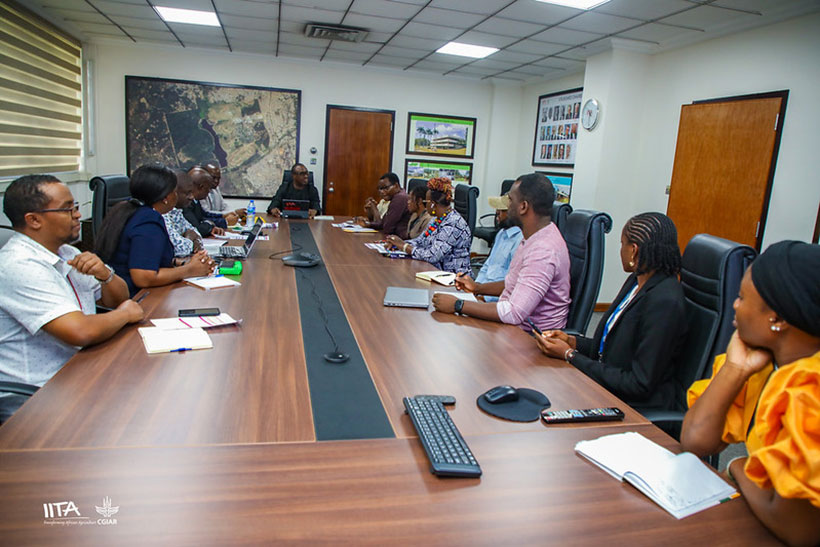
Staff participating in a discussion session during the SARAH retreat in Malawi.
The retreat also identified priority research topics for selected geographies and farming systems. It mapped key research and delivery partners (e.g., NARIs, private sector, countries, regions, and advanced research Institutions) to clearly define our niche and the roles of other players in the agriculture sector in the region. Critical staff, expertise, and science infrastructure needs were identified. Lastly, the retreat deliberated on fundraising to finance our research and delivery portfolio.
Also present at the retreat were students from various universities attached to projects in the institution. Through presentations and panel discussions, the students injected fresh perspectives on new areas of science to improve the transformation of agrifood systems in Southern Africa.
In his review of the past decade, Chikoye disclosed that 14 varieties of soybean were allocated to seed companies in 2023 with TGx-2014-16FM released as GNA emerald selling 60 tons of seed upon release, with a spillover effect to Madagascar and DRC. This variety has also been registered under the SADC catalog.
The approval of a Bill & Melinda Gates Foundation-funded soybean project of US$4.9 million is another landmark achievement by Southern Africa in propelling soybean technologies from speed breeding and genomic selection. He also noted the release of three new cassava varieties in Malawi and Zambia for the fresh and processed markets: CHINANGWA 3 (MM06/0045) and CHILENGWA and KASHIBA in 2024 in Malawi and Zambia, respectively. IITA’s last release of cassava varieties in Malawi was in 2014, whereas in Zambia, it was in 2001. In Mozambique, five soybean genotypes have been submitted for registration and release.
“The great support we are getting from partners is making it all possible for us to contribute to national programs through various projects. As such, we need to have a solidified strategy that plays a role in the transformation of Africa’s food systems through cutting-edge research and innovation,” added Chikoye.
Presenting on the guiding framework for Southern Africa, IITA Economist Julius Manda said Africa has developed many good policies that guide the agriculture sector and asked the participants to ensure that they are adhered to while building partnerships with national programs and the private sector. He cited the Malawi Vision 2063, which has emphasized agricultural productivity and commercialization with a trending focus on megafarms.
As areas to explore, Southern Africa will be looking to adopt artificial intelligence in agronomy for trait identification, remote sensing and drone use, biofertilizer, soil and water conservation techniques, and energy and labor saving techniques, among other areas. Participants further adopted priority areas of genetic innovation in breeding, resilient agrifood systems, and system transformation in social economics.
The last day of the retreat was dedicated to team-building activities that focused on teamwork, accountability, and collaboration. Members were engaged in various activities that simulated actual work-related situations and learned how teams can work together to achieve common goals.
Contributed by Emmanuel Mwale and John Omondi
The Government of Japan and IITA launched a new project to support self-reliance and provide employment opportunities for internally displaced persons (IDPs) in Northeast Nigeria. This is in response to the insecurity situation in the region, where approximately 1.9 million people have reportedly been displaced. These IDPs continue to rely on emergency humanitarian aid to survive, and for over a decade, they have not been able to establish self-sustaining livelihoods.
Beneficiaries of the seed distribution at the IDP camp in Guruku.
The recent economic challenges have worsened the already precarious living conditions in their camps. These difficulties not only affect their lives but also have repercussions on agriculture. The rise in living expenses has increased labor and agricultural input costs. Consequently, obtaining the necessary manpower and agricultural resources has become difficult, with a negative impact on agriculture, which plays a crucial role in Nigeria’s economy, significantly increasing the risk of a food crisis.
IITA is delivering agricultural technologies developed from years of research to increase food production and income in Africa. “We have over 50 years of experience working in agriculture, developing improved varieties, improving seed production systems, and developing the capacity of small-scale farmers. We believe all of these components can be used to provide emergency assistance to IDPs,” project leader Haruki Ishikawa said.
A straightforward response to the challenges faced by the displaced farmers is a project like this that will improve their livelihoods. The project aims to support employment opportunities for IDPs, providing agricultural assistance to increase food production and household nutrition. The project has established a labor dispatch union to send IDPs as temporary workers to farmers facing labor shortages. This activity will provide income sources to IDPs through agricultural work and support their meals during dispatch.
Additionally, the project provides seeds and fertilizers for IDPs who borrow farmland to cultivate for themselves and assists struggling farmers by providing free temporary labor and agricultural inputs—improved seed varieties and fertilizers, enhancing crop productivity.
“One of the major constraints farmers face is the lack of improved varieties’ seeds. The provision of quality seeds to farmers can improve yields significantly, and it is a key component of IDPs who want to go back to the farm, too,” said IITA-Kano System Agronomist Alpha Kamara. In this project, IITA donates certified maize, cowpea, and yam seeds to promote IDPs who were previously farmers. These IDPs have borrowed the farmland around Abuja and re-started farming.
Ambassador Extraordinary and Plenipotentiary of Japan to the Federal Republic of Nigeria, His Excellency Kazuyoshi Matsunaga, said: “I am delighted that Japan’s support for internally displaced persons (IDPs) in Nigeria, in partnership with the International Institute of Tropical Agriculture (IITA), focuses on sustainable solutions rather than merely providing humanitarian aid. This project demonstrates the importance of empowering individuals to improve their lives by promoting self-reliance and addressing food shortages.
As a research institute, IITA’s commitment to solving social issues is commendable, and this initiative serves as a great example of the saying: Give a man a fish, and you feed him for a day; teach a man to fish, and you feed him for a lifetime,” he added.
The IDP-support project using agriculture could contribute to employment and increased agricultural production. The project will also encourage IDPs to become self-reliant and return to agriculture, helping to rebuild the country’s agricultural sector.
Contributed by Ishikawa Haruki
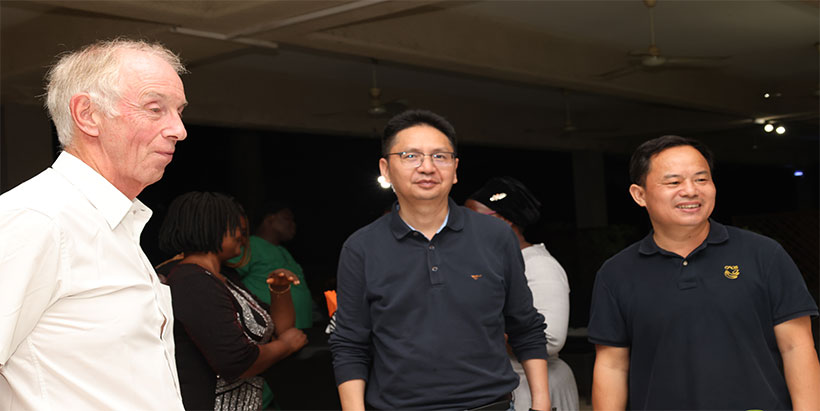
IITA DDG-P4D Kenton Dashiell (extreme right) with CATAS delegates and IITA Banana Breeding Program team members.
Banana is one of the most important staple crops worldwide, following rice, wheat, and maize. In Africa, bananas and plantains are also an important source of income for 5.6 million households and are cultivated on 3.9 million hectares. The forecast is that the production of bananas and plantains over the next 30 years will become 60 million tons annually after cassava and vegetables and ahead of any cereal.
As a mandate crop in IITA, the institute has developed a large expertise in cooking banana and plantain over the past 40 years to improve yields via breeding for pest and disease resistance, seed systems, plant health, and production. The acceleration of the breeding cycle to develop new varieties faster and the release of new varieties has especially attracted more attention from China.
Therefore, Professors Jianghui Xie and Jingyang Li of the Tropical Crops Genetic Resources Institute (TCGRI), Chinese Academy of Tropical Agricultural Sciences, Hainan (CATAS) visited the IITA on 3 September. They visited the Genetic Resource Center and the plantain breeding program.
Their visit aimed to explore collaboration in banana resource innovation and extend opportunities for short-term positions for IITA banana experts at CATAS under China’s talent program.
IITA Banana and Plantain Breeding Program Head Rony Swennen (left) welcoming Professors Jianghui Xie and Jingyang Li of CATAS.
IITA Banana and Plantain Breeding Program Head Rony Swennen welcomed the guests to the institute as he recapped IITA’s banana research activities. “This meeting is of great value to us because China is the largest banana producer worldwide after India, with 12 million tons produced annually. Nigeria produces half of that, and we need to augment that. On the other hand, IITA can provide guidance in banana breeding,” he said.
IITA Deputy Director General, Partnerships for Delivery (DDG-P4D) Kenton Dashiell expressed delight at the knowledge sharing and collaboration, which made the meeting beneficial to both parties. Given that the visit was short, he welcomed further conversation to develop a plan for both teams to work together.
To increase research efforts, align with the country’s agricultural agenda, and define collaborative areas in Sierra Leone, IITA Director General and CGIAR Regional Director for Continental Africa, Dr Simeon Ehui, led a high-level delegation to meet with President Julius Maada Bio and some members of the Sierra Leone government.
Sierra Leone President Julius Maada Bio welcoming IITA Director General Dr Simeon Ehui.
Emphasizing the meeting’s significance to achieving the goal of food sufficiency in Sierra Leone, DG Ehui said that President Bio’s invitation was a welcome development highlighting the strong partnership between IITA and Sierra Leone and their collective commitment to ensuring Sierra Leone’s food security.
President Julius Maada Bio welcomed the IITA team to his office in Freetown, thanking them for accepting his invitation while stressing that agriculture is the foundation of his flagship program, the Feed Salone agenda. He added that while the program has the potential to feed Sierra Leoneans, the country lacked essential elements such as technologies for best practices and improved varieties for increased yield.
The parties discussed the need to align their goals and how IITA can provide the needed support to ensure agriculture in Sierra Leone becomes more productive, generating employment for the teeming youth and stimulating economic growth.
DG Ehui reaffirmed IITA’s commitment to Sierra Leone’s agrifood systems, saying IITA stands with Sierra Leone as a steadfast ally on the path to achieving food security. “Our reach cuts across Africa and beyond, partnering with governments and organizations to uplift communities from poverty and drive sustainable development. We are in Sierra Leone to strengthen existing relationships and explore new collaboration possibilities with your esteemed office,” he said.
IITA Director General and CGIAR Regional Director for Continental Africa Dr Simeon Ehui with Sierra Leone President Julius Maada Bio and the IITA delegation.
President Bio said, “Sierra Leone is looking for a strong seed system to boost the agriculture sector, and with Nigeria’s success in this area, partnering with IITA is remarkable and timely. Knowing that lots of experience will bear in this partnership with IITA is reassuring. We want history to know that IITA was part of our Feed Salone initiative drive.”
In another meeting with the Sierra Leone Minister of Agriculture, Henry Musa Kpaka, the IITA team reassured the Minister of their ability to support the country’s agricultural agenda.
“We can make Sierra Leone a good case study if we put our best foot forward. IITA is optimistic that with the country’s leadership and vision, the right kind of support from other quarters is possible. We are here to listen and reorient our program in Sierra Leone to align with the government’s agenda,” said IITA Development and Delivery Office Director and Sierra Leone Country Representative Alfred Dixon.
Minister Kpaka said, “As IITA was part of the Sierra Leone roadmap development, the institute’s expertise will be leveraged along with other partners. We want to deploy IITA’s youth engagement and development expertise for our country’s youth programs.”
He continued: “Sierra Leone is looking to explore the capacity building that IITA has to offer so that our youth can benefit from building not only PhDs but mid-level ranks within the National Research systems.”
IITA Director General Dr Simeon Ehui with Sierra Leone President Julius Maada Bio.
While IITA has been working with the Sierra Leone government in minor efforts focusing on research development and food security programs, both parties plan to align efforts in areas like seed systems and crops like cassava and rice.
In the days ahead, IITA will deploy innovations from the Technologies for African Agricultural Transformation (TAAT), BASICS-II, and the Nigeria Integrated Agriculture Activity programs to support the Feed Salone agenda.
“With the right partnerships, adequate funding, and clear demand-driven goals, we can leave a legacy of transforming agriculture and food security in Sierra Leone,” DG Ehui said.
This partnership between IITA and the Sierra Leone government could improve the livelihoods of millions of Sierra Leoneans, boost economic development, and strengthen the country’s research and agriculture sectors.
Contributed by Timilehin Osunde
IITA-CGIAR continues to open doors to increasing partnerships and collaboration for agricultural growth and development. On 19 August, we welcomed the Second Secretary of the Australian High Commission, Calum Walker, to the Institute’s headquarters in Ibadan. His visit was to foster collaboration between IITA and the Australian government for specific interventions geared towards capacity development, research solution commercialization, and scaling.
Calum Walker, Second Secretary of the Australian High Commission and Michael Abberton, IITA Western Africa Director and Head of GRC, during Walker’s familiarization tour of IITA GRC facility.
The IITA Western Africa Director and Head of Genetic Resources Center, Michael Abberton, welcomed Calum Walker on behalf of the IITA Senior Management Team and introduced him to IITA’s research focus areas, facilities, hubs, and stations. The brief meeting was followed by a familiarization tour of IITA-CGIAR’s research offices, laboratories, and facilities: Genetic Resources Center (GRC), Germplasm Health, Virology & Diagnostic (GHVD) Laboratory, Cassava Processing Unit, and the Youth-In-Agribusiness Center.
Walker, who works with the Australian High Commission, a business and commercial liaison capacity in Abuja, said it was a pleasure to reenact collaborations with IITA since their last visit in 2021. He then assured the Australian government’s commitment to invest and contribute to food security in Africa. He said, “Australia is looking to provide development funding in Africa towards agricultural research, focusing on food security cum resilience.” He expressed his pleasure at being warmly received by IITA-CGIAR. He said that another set of Australian representatives will visit in December to explore areas of collaboration with IITA-CGIAR to drive agricultural transformation in Africa.
He also highlighted the possibility of identifying undergraduates for studies in Australia, as well as graduates for fellowship and MSc programs in agriculture, climate change, and food systems. These engagements look promising for expanding IITA’s collaboration with Australia.
Kolade Olufisayo and the GHVD team showing Calum Walker the effect of ensuring germplasm health of IITA mandate crops.
Kolade Olufisayo, a Molecular Geneticist at IITA, briefed Walker on IITA’s GHVD work, saying, “We ensure the plant health status of the IITA crops mandate. Our work is to control and manage disease incidences in the movement of plant materials, inter and intra-country.”
At the Cassava Breeding and Processing Center, Walker learned from Ismail Rabbi, IITA Molecular Geneticist and Breeder, that IITA’s cassava breeding pipelines run in West, East, Central, and Southern Africa. Rabbi further explained that IITA’s consistent work in breeding, processing, value addition, and seed systems development of the vital cassava crop and other mandate crops has been impressive over the years.
Ismail added that a team from the University of Queensland in Australia has been friends of IITA for a couple of years, helping to assess our breeding programs and providing recommendations for improvement. Abberton added that the mutual interests of IITA and the Australian High Commission will be represented in the anticipated collaboration and future engagements.
Contributed by Folake Oduntan
IITA Director General Dr Simeon Ehui with some of IITA scientists during discussions with the Angola delegates in Ibadan.
Angolan delegates from the Institute for Agrarian Development (IDA) visited IITA-CGIAR headquarters in Ibadan, Nigeria, from 5 to 9 August. The visit was strategically aimed at bolstering partnership with IITA to deliver proven technologies and support to smallholder farmers in Angola.
The World Bank-funded Smallholder Agricultural Transformation Project (MOSAP 3), which is currently running in Angola, seeks to increase smallholder farmers’ productivity per hectare. Hence, it is seeking collaboration with IITA to deliver all-round solutions for farmers in their Farmer Field Schools.
IDA Director General Felismino da Costa said the various crop improvement solutions, capacity development, and technological packages available in IITA meet the aspirations of the Angolan government, especially for youths and women involved in crop and livestock farming in Angola. Some of their identified intervention directions are maize, sorghum, millet, cassava, beans, and livestock.
Responding to the team’s need to improve seed production for smallholder farmers in Angola, Mercy Diebiru Ojo, IITA Cassava Seed Systems Specialist, said IITA has developed models that combined technology packages for seed production, value addition, and digital technologies for monitoring different crops. These aim to improve productivity, food security, and climate solutions in agriculture.
The team’s visit to Niji Farms and Psaltry Factory exposed the delegates to user-friendly technology solutions suitable for smallholder farmers. Chrysantus Akem, the TAAT Coordinator at IITA, said: “We are already engaged in Angola through the TAAT program—an all-inclusive package for technology deployment covering a wide range of crops and collaboration with sister institutes. The TAAT model can also be adopted in Angola. Your interests in other food components will also be well attended to through our sister partners, riding on the TAAT delivery system.”
Following their weeklong visits to cassava-producing and processing stations within and outside IITA, da Costa said, “We are developing our approach in two ways: we count on IITA’s support to rehabilitate our farmer field schools and replicate the IYA model of youth empowerment in agriculture in Angola.”
For quick take-offs, the team requested IITA deliver technological packages to their field farmers, who will be deployed to replicate these technologies in their fields in September. Consequently, a tripartite agreement between IITA, IYA, and IDA was agreed upon as the first step to implementation preceding host country agreements.
Explaining to farmers about SAH Technology and other technologies.
A significant revolution is underway in Malawi with the introduction of the IITA–CGIAR Semi-Autotrophic Hydroponic System (SAH) technology. This advanced rapid propagation technology was showcased and implemented at the Chitedze Research Station, enabling the swift multiplication of cassava plantlets and heralding a new era of agricultural innovation for the country.
This was carried out to mark the 62nd Chitedze Agricultural Field Day and to commemorate seven decades of dedication to advancing agricultural technologies and services in Malawi.
This significant milestone, themed “70 years of generating and promoting agricultural technologies and providing services for improving agriculture productivity and commercialization in Malawi,” was recently held at Chitedze Research Station. The event also brought together major stakeholders, researchers, policymakers, and farmers in the country.
Different cassava varieties showcased including Chinagwa 3 during the Field day.
Speaking at the event, Malawi’s Minister of Agriculture, Sam Kawale, emphasized that agriculture contributes at least 30% to the country’s GDP. He highlighted that this sector is projected to be the foremost priority in Malawi’s 2063 Agenda, reflecting the government’s commitment to funding agricultural research.
CGIAR Country Convener Dr Gbenga Akinwale stressed the importance of field days as platforms for sharing cutting-edge technologies. He also reaffirmed CGIAR’s commitment to maintaining a strong partnership with the Department of Agriculture Research Services (DARS) in developing transformative technologies that would address farmers’ needs.
In a demonstration of collaboration, IITA worked with its partners at Chitedze Research Station to showcase innovative technologies to enhance agricultural productivity and commercialization in Malawi. Moreover, the IITA Cassava Unit, in collaboration with DARS’s Roots and Tubers Section, introduced a new cassava variety, Chinagwa 3. This variety, resistant to cassava brown streak and cassava mosaic diseases, was unveiled alongside the SAH technology, marking a significant advancement in promoting sustainable cassava cultivation.
Malawi’s Minister of Agriculture, Sam Kawale visits the LEFOG stand.
Minister Kawale concluded by expressing his excitement about the event, noting that the 62nd Chitedze Agricultural Field Day exemplifies the unwavering commitment of Malawi’s agricultural stakeholders to advancing innovation and sustainability in the sector. He added, “IITA’s active participation at the event underscores its dedication to harnessing research and strategic partnerships to tackle the evolving challenges facing agriculture in Malawi and globally.”
Contributed by Theresa Saini and Anita Akinyomade
On 25 July, IITA–CGIAR, under the HealthyDiets4Africa Project, funded by the EU, launched its third living lab in Accra as part of its innovative strategies to combat malnutrition in Ghana and beyond by generating access to more diverse diets for target populations and supporting consumers’ dietary changes toward more diverse diets that are safe to consume.
Ghana Living Lab workshop participants.
During the opening ceremony, IITA Ghana Country Representative Richard Asare welcomed the partners on behalf of the IITA Director General, Dr Simeon Ehui. He assured them of continued support and access to IITA solutions to enhance their farming activities and food production for optimal productivity. He then introduced IITA and the HD4A project. The program continued with interventions and more highlights of the project and workshop objectives. It also featured expected results with Djana Mignouna, the project convener, on behalf of Rousseau Djouaka, the project leader, before other interventions from Titilayo Falade and Carline Santos. Furthermore, the project partners at the workshop shared an overview of their activities, challenges, and successes concerning food security.
The workshop participants worked towards installing and supporting new innovative living labs for various actors of the food chain—producers, processors, traders, or food industry—focusing on two different aspects prioritized for Ghana: (i) Food safety: SOPs, under-and-over use of pesticides; (ii) underutilized and local foods: conservation, source of seeds, etc.
This will be accompanied by data generation for decisions, advocacy for better-informed nutrition policies, and strategies to shape a societal environment conducive to the diversification of the food system. At the end of the workshop, various action programs for the proper implementation of the project were well defined, with different institutions to be associated with the implementation and an innovative mechanism for conducting the implementation, monitoring, and evaluation of programs and action plans to be put in place.
For the closing of the workshop, Robert Asiedu welcomed the achievement of the objectives of this workshop and noted the richness of the discussions, which were of a high level. Indeed, according to him, it is rare to see such encounters between those who design and develop technologies and those who use them. Finally, the participants were urged to continue to work together to achieve the action plans with SMART indicators within a timeframe. According to him, the interest is the impact the living lab will create.
(Concept of living labs as adopted in HD4A (Steen & van Buren 2017)